
 21 min read

In this article9
- Exness deposits and withdrawals: three legs, not one
- Depositing to Exness: channels and timing
- Withdrawing from Exness: why “automatic 24/7” is not the same as instant
- The real cost: three leaks the fee table does not show
- A worked example: what a 500 USD withdrawal actually costs
- The source-of-funds rule — the number-one reason withdrawals fail
- Stuck withdrawal: troubleshooting by symptom
- Frequently asked questions
- Conclusion
Exness is best known for automatic 24/7 withdrawals — a request is processed in seconds rather than waiting for a human to approve it. That is true, but it describes only one leg of your money’s journey. The funds still have to pass through a payment intermediary and one currency conversion before they reach a Vietnamese bank account, and those two legs are where the real cost appears. This guide walks all three legs, plus the rule that gets withdrawal requests rejected and that almost nobody reads in advance.
Last updated: 1 October 2026.
- Exness deposits and withdrawals: three legs, not one
- Depositing to Exness: which channels, how long
- Withdrawing from Exness: why “automatic 24/7” is not instant
- The real cost: three leaks the fee table does not show
- A worked example: what a 500 USD withdrawal actually costs
- The source-of-funds rule — the number-one reason withdrawals fail
- Stuck withdrawal: troubleshooting by symptom
- Frequently asked questions
- Conclusion
Exness deposits and withdrawals: three legs, not one
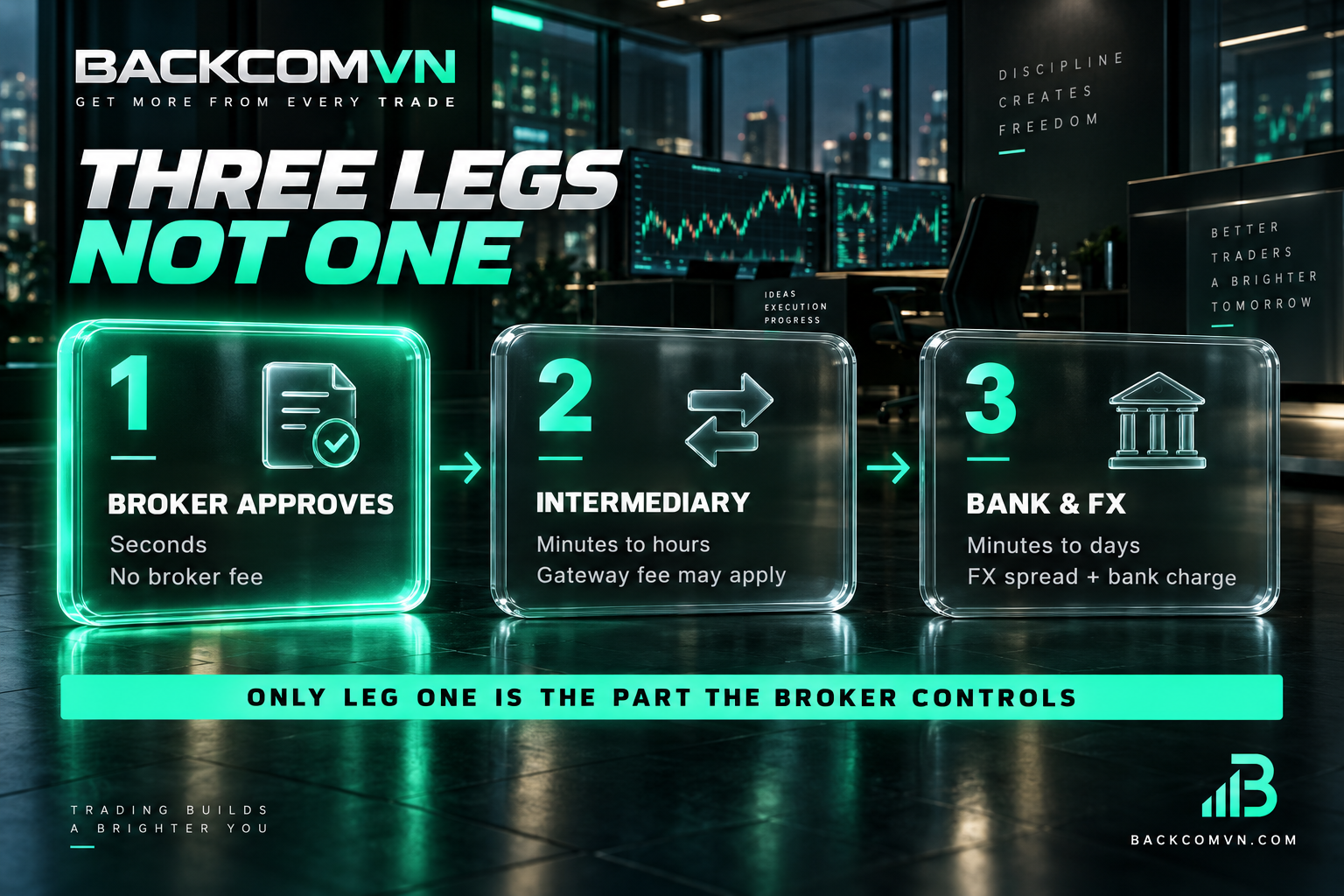
When you hit withdraw in the Exness client area, your money does not travel straight to your bank. It crosses three separate legs, each with its own timing and its own cost:
| Leg | Handled by | Time | Cost |
|---|---|---|---|
| 1. Broker approves the request | Exness | Automatic, seconds to minutes | Exness states it charges nothing |
| 2. Intermediary moves the money | Payment gateway / wallet | Minutes to hours | Possible, varies by gateway |
| 3. Conversion to VND and bank credit | Intermediary + bank | Minutes to days | FX spread, bank charges |
Almost every article about “fast Exness withdrawals” describes only leg 1. That is the leg Exness controls, and the only one that is genuinely fast. The other two sit outside the broker’s hands, which is why asking Exness support where your money is usually produces “the request was completed on our side” — accurate, and no help to you.
Profile facts that bear on cash flow
| Item | Detail |
|---|---|
| Founded | 2008 |
| Brand headquarters | Cyprus |
| Minimum deposit | From 10 USD |
| Account currencies | USD, EUR |
| Withdrawals | Automatic, 24/7 |
| Maximum accounts per KYC document | 10 |
Depositing to Exness: channels and timing
The exact list of deposit channels changes by region and over time, so we do not hard-code a table here — it would be wrong within months. The only correct source is the deposit section of your own client area, which has already filtered by country and by the entity serving you.
Three things hold across every channel, and knowing them in advance saves time:
- Finish KYC first. Exness accepts a national ID, driving licence or passport. You can often deposit before verifying, but you will be blocked at withdrawal — which is how people end up stuck with money already inside the account. See What documents you need to open a forex account.
- The payment channel must be in your own name. Having a relative deposit for you is the fastest way to lock your own withdrawal route.
- The 10 USD minimum is the level the broker stops blocking you, not a sensible starting balance. Size your capital from trading cost instead: How much capital you need to start.
Deposits usually land almost instantly via e-wallets and local gateways, slower via international bank transfer. If the money has not arrived within the window the gateway promised, raise a ticket with the intermediary quoting the transaction reference — not with Exness, which has not received anything yet to trace.
Withdrawing from Exness: why “automatic 24/7” is not the same as instant
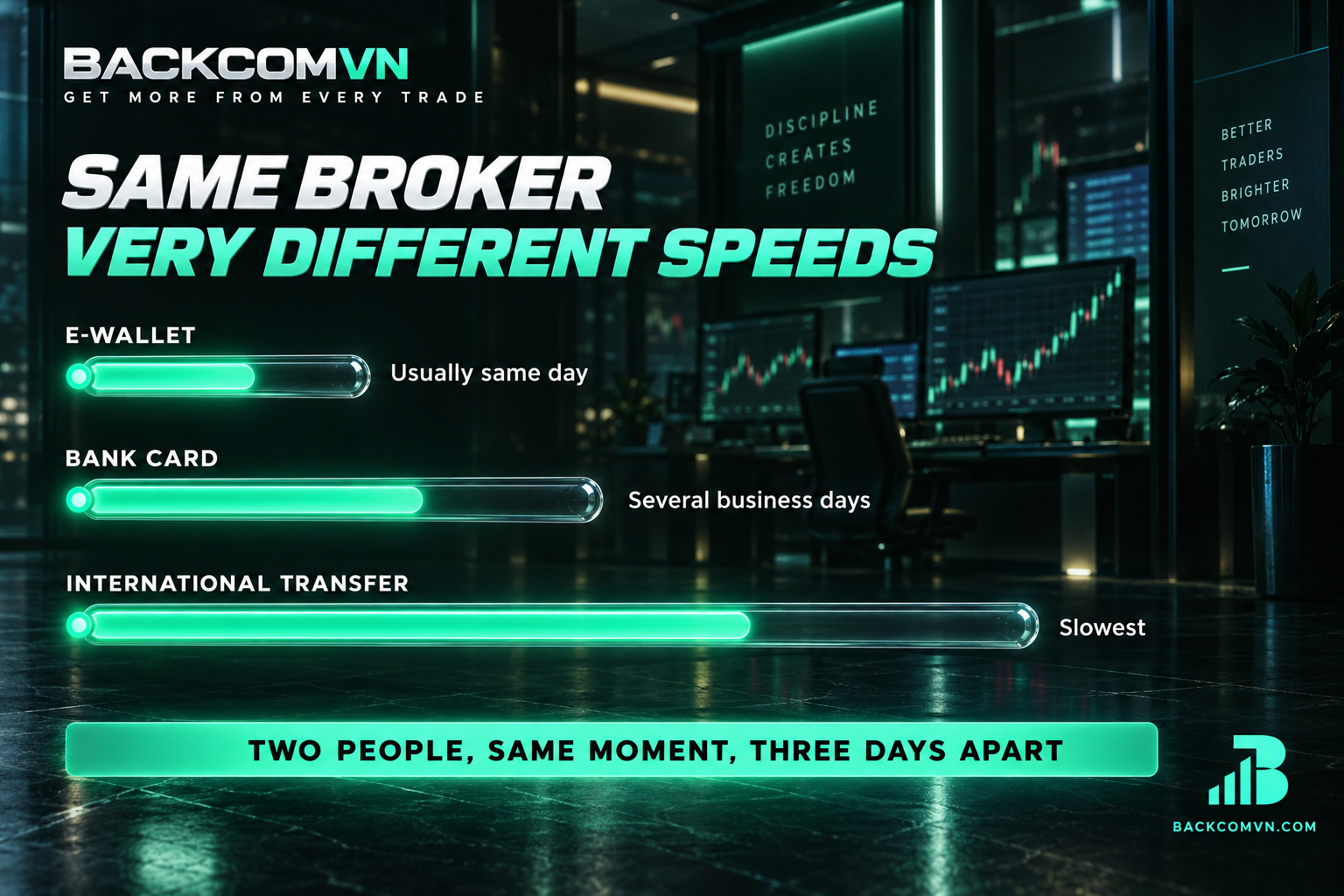
This is the distinction worth being clearest about. Exness processes withdrawals automatically, outside office hours, and its part is usually done in seconds. But “processed” means Exness has pushed the money to the intermediary — not that it has landed in your bank account.
| Withdrawal channel | Broker’s part | Money in your hands |
|---|---|---|
| E-wallet / local gateway | Seconds | Usually same day |
| Bank card | Seconds | Several business days, depends on the issuer |
| International transfer | Seconds | Slowest of the channels |
So the question worth asking is not “is Exness fast” but “how long do legs two and three take on the channel I use”. Two people withdrawing from Exness at the same moment can receive their money three days apart purely because they picked different channels.
Where rebates sit in this flow
With Exness, rebates through Backcom VN are credited straight to the trading account, daily, with no minimum. That means they add no extra leg at all — rebate money sits alongside your capital and can be traded or withdrawn through the same channels described above.
This differs from brokers that pay rebates into a separate wallet, where you must move funds to the trading account before withdrawing — an extra step and sometimes an extra minimum. Compare how eight brokers pay in When and where rebates are paid.
The real cost: three leaks the fee table does not show
Exness states it does not charge fees on many deposit and withdrawal methods. That is true and should be read precisely: it describes the broker’s fees, not the total you lose in transit. These three sit outside the broker’s fee table and still come out of your pocket:
- Intermediary fees. Payment gateways and wallets have their own schedules, usually a percentage. This one appears on the confirmation screen — read it before clicking.
- The FX spread. Your account is denominated in USD; the money arrives as VND. The conversion rate is almost always worse than the interbank rate, and that gap is a hidden fee — typically larger than every visible charge combined. It is also why several small withdrawals cost more than one consolidated withdrawal.
- Receiving-bank charges. Some banks charge on inbound international funds. This appears nowhere in the Exness interface.
The cheapest way to find out: on your first withdrawal, take out a small amount, record exactly what left the trading account and what arrived at the bank, and take the difference. That figure is your real withdrawal cost on that channel — and you pay the tuition only once. General ways to reduce it: Deposit and withdrawal fees, and how to cut them.
A worked example: what a 500 USD withdrawal actually costs
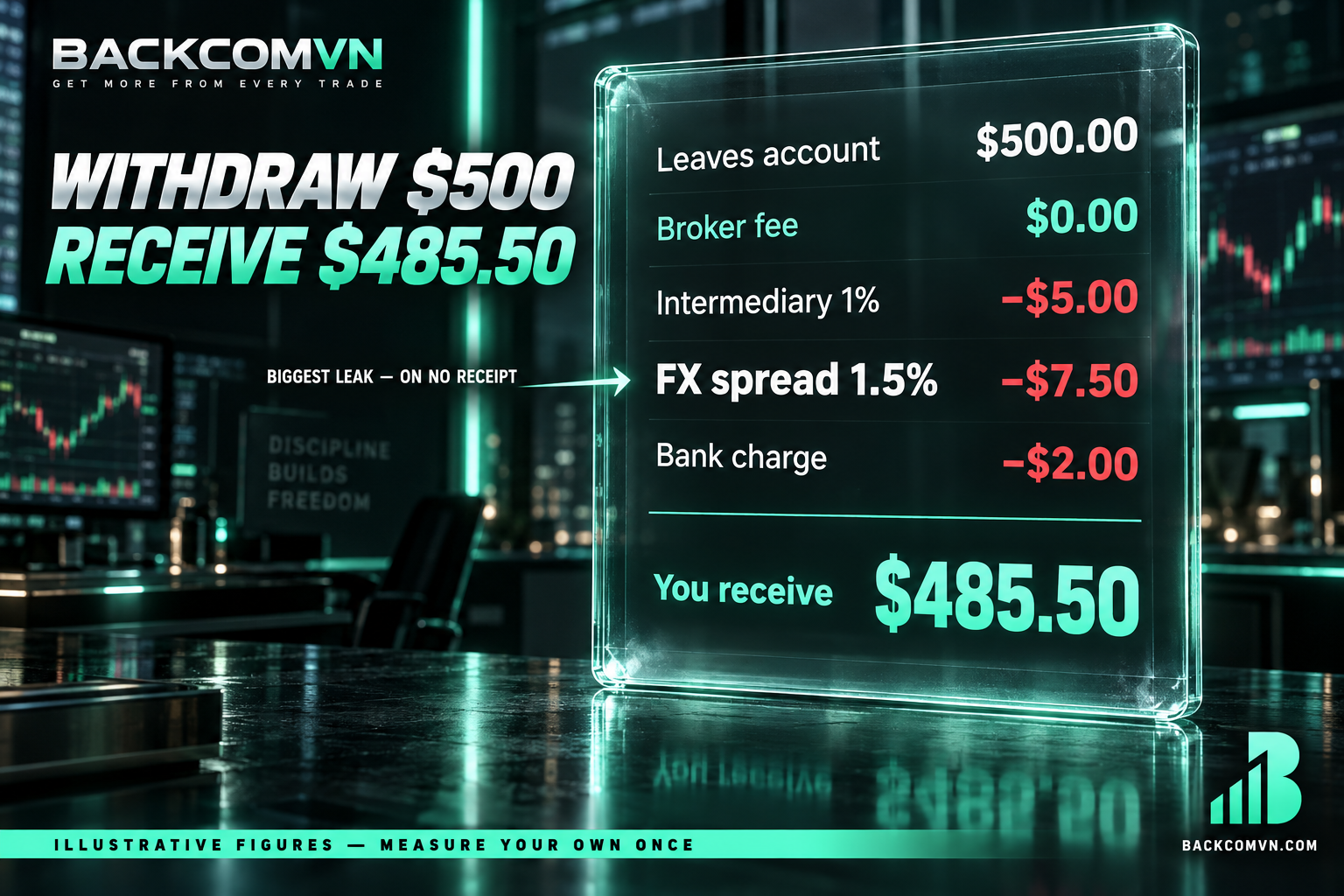
This illustrates the method, not the broker’s real schedule — fees change by channel and over time, so the numbers below are assumptions that show where the three leaks are and which one is biggest. Say you withdraw 500 USD to a Vietnamese bank:
| Item | Assumption | Amount |
|---|---|---|
| Leaves the trading account | — | 500 USD |
| Broker fee | Broker states none | 0 USD |
| Intermediary fee | 1% of the amount | −5.0 USD |
| FX spread | Conversion 1.5% worse than interbank | −7.5 USD |
| Receiving-bank charge | Flat amount, around 2 USD | −2 USD |
| Actually received | ≈ 485.5 USD |
Two conclusions follow, and both change how you should operate:
- The biggest item is the FX spread, not a fee. It appears on no confirmation screen, so most people never see that they paid it. This is why a broker that withdraws “for free” can still be more expensive than one that charges a fee but converts well.
- Flat charges punish small withdrawals. A flat 2 USD is 4% of a 50 USD withdrawal but only 0.4% of a 500 USD one. Consolidating into one withdrawal a month is almost always cheaper than taking money out weekly.
Run this same arithmetic once with your own figures: record what left the trading account, record what reached the bank, take the difference and divide by the amount withdrawn. That percentage is your real withdrawal cost on that channel.
The source-of-funds rule — the number-one reason withdrawals fail
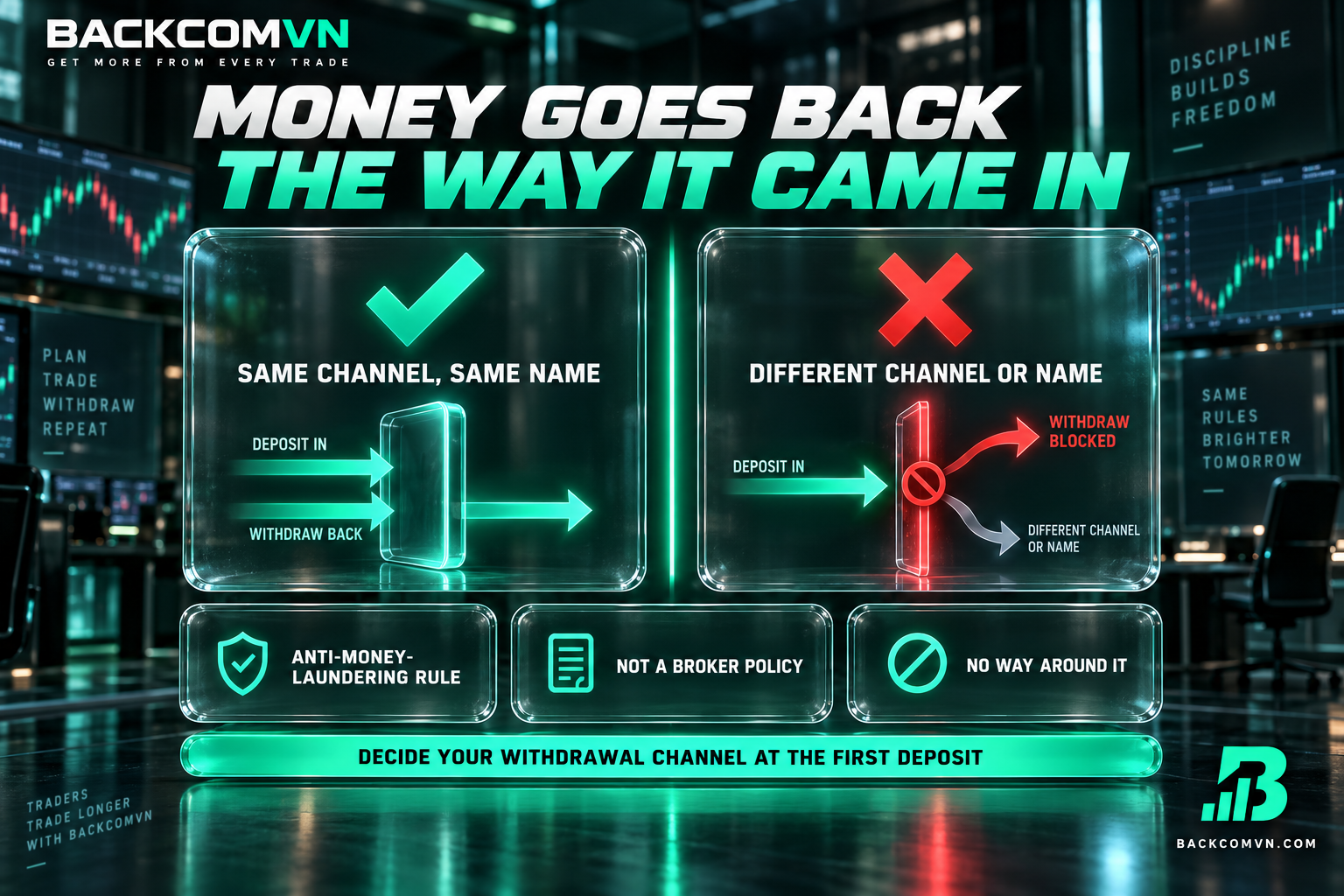
Here is the rule almost nobody reads in advance, and the cause of most “I can’t withdraw” cases: money must go back out through the same channel it came in, and in the same account holder’s name.
This is not the broker being awkward. It is an anti-money-laundering requirement on every licensed financial firm: outgoing funds must be traceable back to incoming funds, and to the same person. In practice:
- Deposited via wallet A, and the matching amount must go back to wallet A first — not straight to a bank.
- Deposited from a bank account in a relative’s name, and a withdrawal in your name will be rejected — and unwinding that is slow.
- Where you deposited through several channels, profit above your deposited capital is usually more flexible, while the principal must return the way it came.
Which gives one practical rule: on your very first deposit, pick the channel you also want to withdraw through, in your own name. A minute of thought at the deposit step saves days of correspondence at the withdrawal step.
Stuck withdrawal: troubleshooting by symptom
| Symptom | Usual cause | Fix |
|---|---|---|
| Withdraw button greyed out or marked ineligible | KYC not complete | Resubmit documents, wait for approval |
| Request rejected immediately | Wrong channel or wrong account name | Withdraw via the channel you deposited with, in your own name |
| Broker says processed, money not arrived | Sitting at the intermediary or the bank | Raise a ticket with the intermediary, quoting the reference |
| Less arrived than you withdrew | Intermediary fee and FX spread | Normal — measure it with the small-withdrawal test above |
| Cannot withdraw although there is a balance | Funds held as margin on open positions | Only free margin can be withdrawn |
The last row is the most commonly misread: the balance shown is not the amount you can withdraw, because whatever is carrying open positions is locked. See Balance, equity and free margin. The full ordering for any broker is in Can’t withdraw from your broker: six causes.
Frequently asked questions
Does Exness charge withdrawal fees
Exness states it does not, on many methods. But intermediary fees, the FX spread on conversion to VND and receiving-bank charges still apply — and together they usually exceed what people expect. Measure with a small withdrawal before taking out a large amount.
How long does an Exness withdrawal take
The broker’s part is usually seconds, because processing is automatic and runs 24/7. Time to reach you depends on the channel: e-wallets and local gateways usually same day, bank cards several business days, international transfers longest.
What is the Exness minimum deposit
From 10 USD. But that is the level at which the broker stops blocking you, not a balance sufficient to trade with discipline.
Can I withdraw to someone else’s bank account
No. The receiving account name must match the trading account holder. This is a general anti-money-laundering requirement rather than an Exness policy, so there is no way around it — and attempting one usually ends in a locked account.
Are Exness rebates withdrawn separately from capital
No, together. Rebates are credited straight to the trading account, so they sit with your capital, carry no minimum and need no wallet transfer.
Does opening several Exness accounts give more flexibility
Exness allows up to 10 accounts per KYC document. But that does not get around the source-of-funds rule — each account still has to pay out through the channel it was funded from, in your own name.
Conclusion
Automatic 24/7 withdrawal is a genuine Exness strength, but it only solves the first of three legs. Two other things decide your actual experience: choose your channel at the first deposit, because money must return the way it came and in your name; and measure the real cost with one small withdrawal, because the largest leak is the FX spread rather than any broker fee.
Get those two right and the rest rarely becomes a problem. Current trading conditions and rebate rates are on the Exness broker page; the entity and licence review is in Is Exness trustworthy.
This content is informational. It is not investment advice and not a promise of returns. Leveraged forex and CFD trading carries a high level of risk and can result in the loss of all invested capital. Deposit and withdrawal policies, channel lists and fee schedules — the broker’s and the intermediaries’ — can change; verify them in your own client area before acting.
Related articles

XM deposits and withdrawals: My Wallet, the 2–5 day window and real costs
At XM your money sits in two places, not one — and that is behind almost every 'where are my…

Vantage deposits and withdrawals: the same-name rule and the 50 USD minimum
Vantage states the rule other brokers let you discover the hard way: funds must be in the same account holder's…

IC Markets rebate: four ways it differs from the rest
The rebate goes to an intermediary wallet rather than the trading account, account types differ sharply, and crypto is counted…