
 The Backcom VN editorial team
36 min read

In this article8
- What the five Exness account types are
- Standard and Standard Cent: the two entry-level options
- Pro, Raw Spread and Zero: the three high-volume options
- Which Exness account is cheapest? Net cost on one lot
- How the Exness rebate reverses the comparison
- Which Exness entity are you contracting with?
- Frequently asked questions about Exness account types
- Conclusion
Last updated: 17/09/2026
Exness currently divides its offering into five account types — Standard, Standard Cent, Pro, Raw Spread and Zero — but the spread alone will not tell you which one actually costs less to trade. Most comparison tables stop at the quoted spread and conclude that Raw Spread is the cheaper option, while the real calculation also has to account for commission and for the Exness rebate.
This article from backcomvn.com puts all three items into a single sum: spread + round-turn commission − rebate, applied to one lot of EURUSD so that the net cost of each account type becomes visible. From there you can decide which Exness account suits your trading volume, your usual instruments and the way you enter positions, rather than choosing one because the marketing says “spreads from 0.0 pips”.
Contents
- What the five Exness account types are.
- Standard and Standard Cent: the two entry-level options.
- Pro, Raw Spread and Zero: the three high-volume options.
- Which account is cheapest? Net cost on one lot.
- How the rebate reverses the comparison.
- Which Exness entity are you contracting with?
- Frequently asked questions and conclusion.
What the five Exness account types are
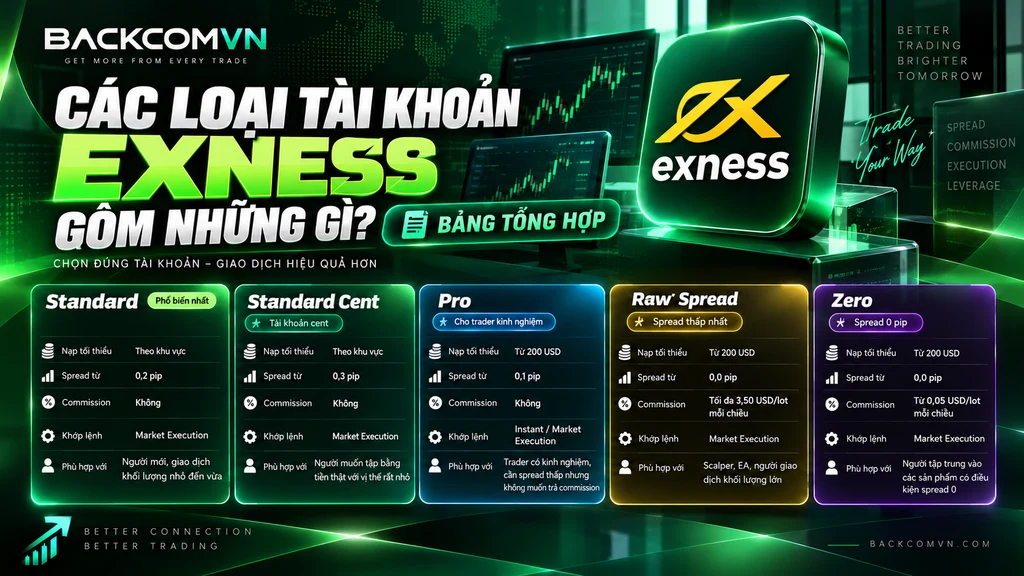
According to Exness documentation there are five main choices. The first two belong to the Standard group; the remaining three belong to the Professional group. Figures below were recorded on 17/09/2026.
| Account type | Minimum deposit | Spread from | Commission | Execution | Who it suits |
|---|---|---|---|---|---|
| Standard | Depends on payment method and region | 0.2 pips | None | Market Execution | Beginners, small to moderate volume |
| Standard Cent | Depends on payment method and region | 0.3 pips | None | Market Execution | Traders who want live money at very small position sizes |
| Pro | From 200 USD* | 0.1 pips | None | Instant / Market Execution** | Experienced traders who want a low spread without a separate commission |
| Raw Spread | From 200 USD* | 0.0 pips | Up to 3.50 USD per lot per side | Market Execution | Scalpers, EAs, high-volume traders |
| Zero | From 200 USD* | 0.0 pips | From 0.05 USD per lot per side | Market Execution | Traders focused on instruments with zero-spread conditions |
* The first deposit can be higher in some countries. Exness publishes Professional accounts from 200 USD in some regions, and its Help Center also lists a 200 USD first deposit for Pro, Raw Spread and Zero for clients in Vietnam. The figure shown inside your own Personal Area is the one to check before funding.
** Pro is the only Exness account type that supports Instant Execution. Current documentation indicates Pro can also use Market Execution in some cases; Standard, Standard Cent, Raw Spread and Zero use Market Execution.
The clearest point from the table is that Standard, Standard Cent and Pro charge no separate trading commission, while Raw Spread and Zero move part of the cost into commission. Raw Spread quotes spreads from 0.0 pips but commission can reach 3.50 USD per lot per side; Zero charges from 0.05 USD per lot per side depending on the instrument.
The difference in execution also matters. Market Execution fills at the best available market price, so slippage is possible; Instant Execution attempts to fill at the requested price and may return a requote if the price has moved. Because Pro is the only type offering Instant Execution, short-term traders should weigh that point rather than looking only at the spread difference.
Standard and Standard Cent have a lower capital barrier, while Raw Spread, Pro and Zero sit in the Professional group with a higher first deposit. The table only shows the published fee structure, however. To establish which type is genuinely cheaper, you have to combine spread, round-turn commission and the rebate on the same trading volume.
Standard and Standard Cent: the two entry-level options
Both belong to the group with no separate commission. The important difference is position scale: Standard uses standard lots and supports a wider instrument range, while Standard Cent uses cent lots to reduce the real size of each trade substantially.
Standard: a reasonable default for most people starting out
Standard quotes spreads from 0.2 pips, charges no commission and uses Market Execution. The minimum trade size is 0.01 lot, so profit, loss and position sizing work the same way as on the account type a trader is likely to use over the long run.
The trade-off for paying no separate commission is a spread that is usually wider than on Raw Spread or Zero. Standard is therefore not automatically cheaper simply because the fee schedule says “0 commission”. It suits you better when you are starting out and not yet trading large volume, when you want a simple cost structure held mostly inside the spread, when you trade several instrument groups rather than a few pairs, and when you do not yet need to optimise small fractions of cost for scalping or an EA.
Standard Cent: live money at a small risk
Standard Cent fits the stage between a demo and a standard account. You still trade real money and feel the real psychological effect of a gain or a loss, but at a markedly smaller position size. The point to understand is that one cent lot is not one standard lot: a standard lot is 100,000 units of the base currency, a cent lot is 1,000 units, so one cent lot equals 0.01 standard lots. The 0.01 cent lot minimum is equivalent to 0.0001 standard lots in scale.
For example, depositing 10 USD into an account denominated in USC shows a balance of 1,000 USC. The number on screen is 100 times larger, but the real monetary value is unchanged. That makes Standard Cent useful for testing how you place a stop loss, manage capital or run a strategy in the live market without increasing position size too early. If you are not yet comfortable with MT4 or MT5, the more sensible route is to use a demo account properly first, and then move to Standard Cent to test your psychology and discipline with real money.
Standard Cent has its own limits: a narrower instrument range than Standard, and a cent-lot structure that stops being necessary once you are used to managing positions on a normal account. When volume rises and the cost per lot starts to matter, Pro, Raw Spread and Zero become the three options worth comparing directly.
Pro, Raw Spread and Zero: the three high-volume options
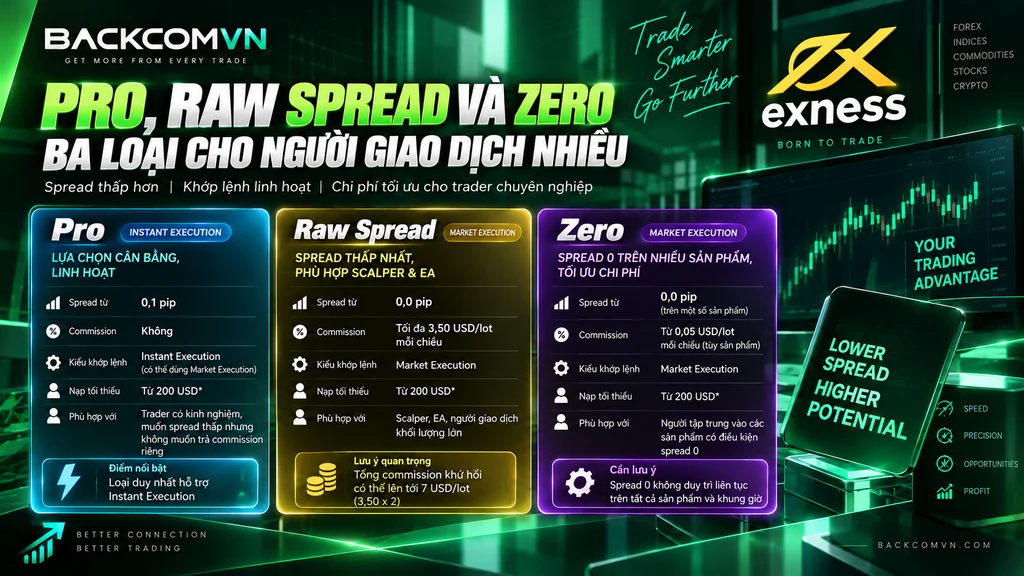
These three form the Professional group. What they share is a lower starting spread than the Standard group and a higher regional first deposit; what separates them is execution and how cost is distributed between spread and commission.
Pro: the only type using Instant Execution
Pro quotes spreads from 0.1 pips and charges no separate commission. Its main distinction is support for Instant Execution on forex and most ordinary instrument groups, with Market Execution available in some cases. Under Instant Execution the order attempts to fill at the price you requested; when the market moves quickly and that price is no longer available, you may receive a requote instead of a fill at the next market price.
Pro therefore suits a trader who wants a low spread while keeping a commission-free structure. Conversely, very short-term scalpers and EAs that are sensitive to fill speed should weigh the requote mechanism rather than looking only at the 0.1 pip figure.
Raw Spread: from 0.0 pips, with commission charged separately
Raw Spread quotes spreads from 0.0 pips, uses Market Execution and charges a commission of up to 3.50 USD per lot per side on most instruments. The phrase “per side” is what matters. If an instrument is charged the full 3.50 USD per lot per side, a 1 lot trade opened and closed carries a round-turn commission of up to 3.50 × 2 = 7 USD per lot.
This is the item many people omit after seeing a 0.0 pip spread and concluding that Raw Spread must be the cheapest. The full conversion is set out in our article on how forex commission is calculated. Raw Spread is worth considering for scalpers, EAs and high-volume traders across many instruments, but the real cost has to be spread plus round-turn commission, not the spread on its own.
Zero: zero spread on some instruments, during some hours
Zero also quotes from 0.0 pips and uses Market Execution, but “Zero” does not mean every instrument holds a zero spread continuously. According to Exness, the 30 most-traded instruments can maintain a zero spread for most of the trading session; the remaining instruments have a zero spread only part of the time, and that condition still depends on market volatility. During strong news, rollover or a change in liquidity, the spread can still rise above zero.
Zero also charges commission per instrument. It therefore suits you better when you concentrate on a few pairs or instruments with favourable zero-spread conditions, rather than treating Zero as an account with no spread at all. If you are still undecided between the three Professional types, it is worth reading Exness’s own account recommendations as well: Exness groups Pro, Raw Spread and Zero for more experienced traders, but the right type still depends on your strategy and your cost structure.
Which Exness account is cheapest? Net cost on one lot
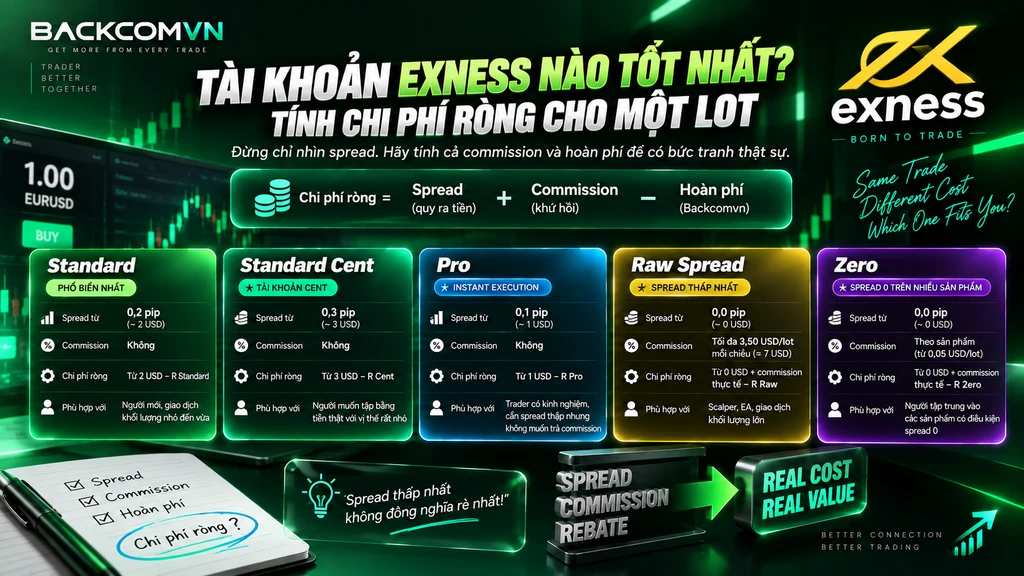
You cannot rank the account types by spread alone. For the same trade, the real cost has to add commission and then subtract the amount paid back:
Net cost = spread converted to money + round-turn commission − rebate
Take one lot of EURUSD opened and closed the same day, so swap is excluded. On EURUSD, one pip on a standard lot is worth about 10 USD, so a 0.2 pip spread is roughly 2 USD and 0.1 pips roughly 1 USD. To avoid turning a variable spread into a fixed number, the table below uses the “from” figures Exness publishes. The real cost at the moment of execution can be higher, particularly when liquidity is thin or the market is moving.
| Account type | Spread in USD* | Round-turn commission | Net cost after rebate |
|---|---|---|---|
| Standard | From 2 USD | 0 USD | From 2 USD − R Standard |
| Standard Cent** | From 3 USD | 0 USD | From 3 USD − R Cent |
| Pro | From 1 USD | 0 USD | From 1 USD − R Pro |
| Raw Spread | From 0 USD | Up to 7 USD | From 0 USD + actual commission − R Raw |
| Zero | From 0 USD | Per EURUSD at the time of trading | From 0 USD + actual commission − R Zero |
* The calculation uses starting spreads of 0.2 pips for Standard, 0.3 pips for Standard Cent, 0.1 pips for Pro and 0.0 pips for Raw Spread and Zero. These are not fixed spreads. ** Standard Cent is converted to a volume equivalent to one standard lot so the comparison rests on the same basis; in practice this account type is mostly used with much smaller positions. R Standard, R Cent, R Pro, R Raw and R Zero stand for the rebate actually received on one lot of EURUSD — take those values from the current Exness rebate table at Backcom VN rather than from an older figure or one inferred from a different instrument.
Why “lowest spread” does not mean “cheapest”
Raw Spread is the clearest example. The spread can start at 0.0 pips, but if the instrument’s commission is 3.50 USD per lot per side, opening and closing one lot costs 7 USD in round-turn commission. Standard, meanwhile, charges no separate commission. If the actual spread when you open is 0.8 pips, the spread cost is roughly 8 USD — so the gap before any rebate is about 1 USD, not “0 pips against 0.8 pips”.
That is also why the question of which broker has the lowest spread is always missing half the answer when commission and rebates are left out. Once the Exness rebate enters the calculation, the gap can shift again. Standard and Pro generate partner commission based on the spread, while Raw Spread and Zero use a fixed amount per lot that varies by instrument. There is no basis for looking at the spread alone and assuming the lowest figure produces the lowest net cost.
Recommendations by trading profile
Rather than asking in the abstract which Exness account is best, place each type next to the way you actually trade.
| Trading profile | Main instruments or needs | Type to consider |
|---|---|---|
| New, small capital, testing live trading | Forex, very small positions | Standard Cent |
| New but used to standard lots, low to moderate volume | Forex, gold, several instrument groups | Standard |
| Intraday, moderate volume, wants a low spread without separate commission | EURUSD, GBPUSD, XAUUSD | Pro |
| Scalper or EA, many instruments and high volume | Forex, metals, many symbols | Raw Spread |
| Scalper focused on instruments that hold a zero spread most of the time | Major pairs in the Zero group | Zero |
| Holding positions for several days | Forex or metals | Check swap before choosing an account type |
For a scalper or an EA, a few dollars per lot becomes a meaningful amount once multiplied by dozens or hundreds of lots a month. Someone trading one or two lots a month should usually prioritise capital management and position sizing over optimising a few tenths of a pip. That is also the reason to look at forex trading costs as a whole instead of treating spread, commission and swap as independent items. Most importantly, the table above is not the final calculation: only when R is replaced with the real rebate for each account type do you have a net cost that can be compared directly — and that step can change the order between Standard, Pro, Raw Spread and Zero.
How the Exness rebate reverses the comparison
The Exness rebate does not change whether a trade wins or loses, but it does change the net cost a trader actually bears. It comes out of the partner or IB reward and can be shared back with the referred client. Exness confirms that the rebate system within its IB programme allows a partner to share part of that reward with clients. The registration procedure and payment cycle are covered in our guide to claiming the Exness rebate.
What matters is that the rebate is not formed the same way across account types:
- Standard and Standard Cent: partner commission is a percentage of the spread and depends on the partner tier.
- Pro: also based on the instrument’s average spread and the partner tier.
- Raw Spread and Zero: partner commission is a fixed amount per lot that varies by instrument.
So for the same one-lot trade, the rebate on a Standard account is not necessarily equal to Pro or Raw Spread. This is precisely the missing side of the equation if you rank cost using spread and commission alone.
Rebate levels by account type
It would be wrong to publish a single fixed rebate figure for the whole of Exness, because the amount actually received depends on the account type, the instrument, the volume and the commission mechanism in force at the time of the trade. Instead of copying a table that can change, check the current Exness rebate by instrument at Backcom VN before running your cost calculation.
Using the table is straightforward. Suppose the pre-rebate cost of a trade is 8 USD and the corresponding rebate is 3 USD: the net cost is 8 − 3 = 5 USD. Trade 50 lots a month under the same conditions and that 3 USD per lot alone is worth 3 × 50 = 150 USD a month.
That is why the question of which Exness account is best should not be answered with “Raw Spread, because the spread starts at 0 pips”. A type with a wider spread can still close the cost gap once the rebate is deducted; conversely, a type with a very low spread still has commission to add. The final comparison is always: spread + commission + swap if applicable − rebate = net cost. If you close within the day, swap can be left out. If you hold overnight, it has to go back in before you compare.
Does taking a rebate make the spread worse?
Mechanically, a rebate is not a surcharge added to the spread on your order. Exness describes its IB programme as a partner receiving a reward from client trading activity, with the rebate system then allowing part of that reward to be shared back with the referred client. In other words, two things need to be kept apart: the trading conditions — spread, commission, swap and execution — and the rebate, which is money returned after a qualifying trade has been recorded.
This does not mean an Exness spread is always fixed. Spreads can still widen or narrow with the instrument and market conditions; but receiving a rebate should not be assumed to be the cause of a wider spread. If you want to examine the mechanism before registering, see our separate analysis of whether a rebate affects your spread.
Treat the rebate as a deduction from the final cost, then — not as a reason to ignore spread or commission. The more lots a trader runs, the clearer its effect on total cost; at low volume, risk management and position sizing still matter more than optimising a few dollars of trading cost.
Which Exness entity are you contracting with?
When comparing Exness account types, spread and commission are not the whole story. Another thing to check before funding is which Exness entity actually appears in your agreement. Exness is a group of several entities operating under different licences. According to its licence page, the list includes Exness (SC) Ltd in Seychelles, Exness B.V. in Curaçao, Exness (VG) Ltd in the BVI, Exness (MU) Ltd in Mauritius, along with entities regulated in other regions. For example:
- Exness (SC) Ltd: FSA Seychelles, licence SD025.
- Exness B.V.: Central Bank of Curaçao and Sint Maarten, licence 0003LSI.
- Exness (VG) Ltd: FSC BVI, licence SIBA/L/20/1133.
- Exness (Cy) Ltd: CySEC, licence 178/12.
- Exness (UK) Ltd: FCA, Financial Services Register 730729.
The point that most often causes confusion is that a brand holding an FCA or CySEC licence does not mean every client’s retail account is opened under that same entity. Exness states clearly that Exness (Cy) Ltd and Exness (UK) Ltd do not provide trading services to retail clients. Exness (SC) Ltd, by contrast, serves a number of jurisdictions outside the EEA. CySEC separately confirms that Exness (Cy) Ltd holds licence 178/12, granted on 05/09/2012, with exness.eu as the approved website.
So the thing to check is not “does Exness have an FCA licence”, but which entity’s name appears in your own account agreement and which authority supervises that entity. The legal framework, the complaints mechanism and the protections available to clients can differ by region. If you want to understand those differences more fully, see our comparison of FCA, ASIC and CySEC.
How to verify it yourself in two minutes
You do not need to rely on the licence logos on a website. Four steps are enough. Open the agreement or Legal Documents inside your Exness account and find the entity named at the top — for instance Exness (SC) Ltd or Exness B.V. Record the entity name and the licence number, rather than searching only for the word “Exness”, because the same brand covers several different companies. Then open the regulator’s own website: Exness publishes FCA registration number 730729 for Exness (UK) Ltd, which you can check against the Financial Services Register, and Exness (Cy) Ltd with licence 178/12 can be verified directly in the CySEC list of licensed investment firms. Finally, match the company name, the licence number and the website: all three should agree, because a matching brand name alone does not identify the entity signing your agreement.
This check does not decide whether you should choose Standard, Pro or Raw Spread, but it answers a more important question: in a dispute, which legal framework does your agreement sit under? Before optimising a few dollars of spread, commission or rebate, spend two minutes identifying the entity. Trading costs can be compared again at any time; the entity named in your agreement is the legal basis of your relationship with the broker.
Frequently asked questions about Exness account types
Can I switch from one account type to another?
No. Exness does not convert an existing Standard account into Pro, Raw Spread or Zero after it has been created. To use a different type you open a new trading account inside the same Personal Area, choose the type you want and transfer the appropriate funds into it. You do not need to register a new Exness profile just to change account type.
Which Exness account is best for a complete beginner?
For someone new, Standard is usually the more accessible starting point: no separate commission, standard lot sizing, and a first deposit that depends on payment method and region. To test the live market at an even smaller scale, Standard Cent suits better thanks to cent lots. Exness also groups Standard as appropriate for new and intermediate traders. If you are not yet comfortable placing orders and managing risk, a demo account should still come first.
How do Raw Spread and Zero differ?
Both use Market Execution, quote from 0.0 pips and charge a separate commission, but they structure cost differently. Raw Spread has a fixed commission per instrument, up to 3.50 USD per lot per side on most instruments, in exchange for a very low spread. Zero focuses on zero-spread conditions on selected instruments for most of the session: Exness publishes that the 30 most-traded instruments hold a zero spread around 95% of the time, though the spread can still rise during strong moves, economic news or rollover, and Zero’s commission also varies by instrument. In short, Raw Spread suits trading many instruments with a consistently low spread; Zero is worth considering when your strategy concentrates on instruments that frequently hold a zero spread.
Which account type earns the highest Exness rebate?
Standard is usually the first type to check when the goal is to optimise the rebate per lot. The rebate should not be viewed in isolation from the spread, however: receiving more back while paying a wider spread does not necessarily produce a lower net cost. Take the current rebate from the table above and put it into the same formula — net cost = spread + round-turn commission − rebate. The type with the highest rebate is only genuinely better when the final net cost is lower for the instrument and volume you actually trade.
Conclusion
The Exness account types fall into two groups that are easy to hold in mind: Standard and Standard Cent charge no separate commission; Pro, Raw Spread and Zero are aimed more at experienced traders, with Raw Spread and Zero moving part of the cost into commission.
The most important point is not to choose an account on the lowest spread alone. To find out which Exness account is best for you, run the calculation on the instrument and volume you actually trade: net cost = spread + commission + swap if applicable − Exness rebate. For beginners or low volume, Standard and Standard Cent are usually easier to manage. At high volume, scalping or running an EA, Pro, Raw Spread and Zero deserve to be compared on real net cost rather than on advertised figures.
Finally, before you deposit, check which Exness entity is named in your agreement and which authority supervises it. A brand holding several licences does not mean every client signs with the same entity or receives the same protections. If you want to check current rebate levels before choosing an account, see the Exness rebate by instrument at Backcom VN and substitute the amount you would actually receive into the cost calculation above.
Leveraged forex and CFD trading carries a high level of risk and can result in the loss of all your capital. This content is for information and analysis only and is not investment advice or a trading recommendation. Spreads, commissions, swaps, minimum deposits, rebates and account conditions can change by time, instrument, region and legal entity. Check the details directly with Exness and assess the risks before trading with real money.
The Backcom VN editorial team
The Backcom VN editorial team tracks forex trading costs: the fee schedules, rebate levels and licences of eight brokers, together with the market figures that feed into the cost of each trade. Every number we publish carries a public source and the date it was accessed, so you can check it yourself.
Related articles

Which HFM account to choose - and one inconsistency in the published data
HFM has three account types with a $0 minimum. But the summary quotes up to $18/lot while the account-type table…

XM pays the rebate into My Wallet: what changes and what to watch
XM is one of the few large brokers that pays into a separate wallet rather than the trading account. One…

Which Exness account to choose: the five types side by side
The rebate across Exness's five account types varies almost fivefold, from $3 to $14.40 a lot. But the high rebate…

Is a 100% rebate real? Taking the claim apart
The claim can be technically true and still completely misleading, depending on what follows the word "of". Four questions that…

Seven common misconceptions about trading rebates
A rebate is a simple mechanism surrounded by confusion, most of it created by how the industry advertises it. The…

When rebates arrive and where: eight brokers compared
Most forex brokers pay daily, but the destination differs: the trading account, the broker's own wallet, or an intermediary wallet.…