
 The Backcom VN editorial team
29 min read

In this article7
Last updated: 18/09/2026
A Vantage Cent account is often treated as the gentle option for beginners, and a swap-free account easily creates the impression that holding overnight costs nothing. Both readings are missing an important side of the equation: a Cent account has to be assessed against Vantage’s rebate policy, and swap-free does not remove the cost of holding a position — Vantage applies an administration fee in place of swap.
This article from backcomvn.com separates those two mechanisms so you can calculate the cost correctly and decide when each account type is genuinely useful. If you are weighing Standard STP against RAW ECN, the cost comparison for those two is analysed separately in our article on Vantage Standard STP or RAW ECN, and which is actually cheaper.
Contents
- What a Vantage Cent account is, and how it differs from a demo.
- How a Cent account receives the Vantage rebate.
- How a swap-free account works.
- The administration fee that replaces swap.
- When to choose each, and when to go back to Standard STP.
- Frequently asked questions and conclusion.
What a Vantage Cent account is, and how it differs from a demo
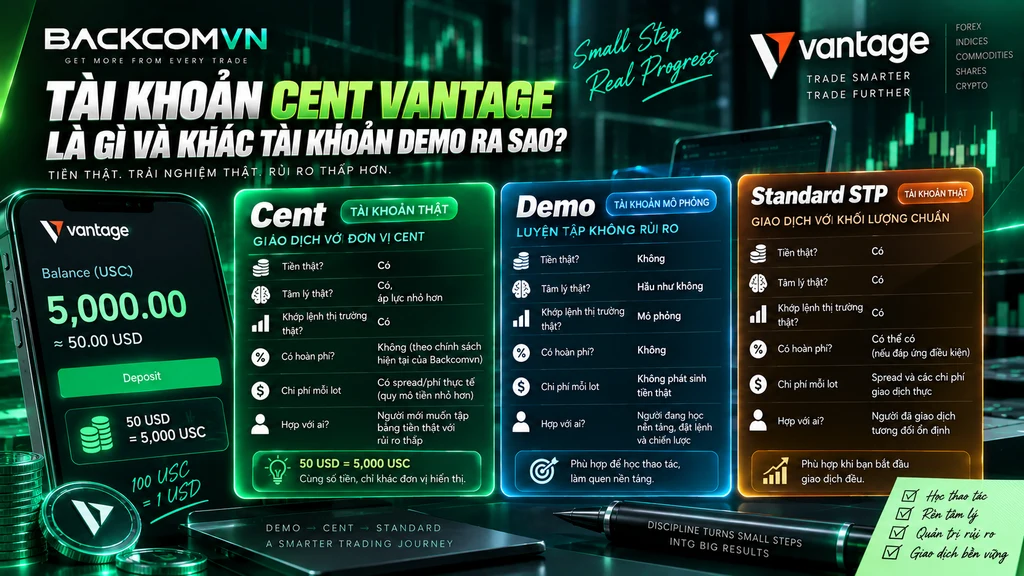
A Vantage Cent account trades real money, but the balance is converted and displayed in cents. Because position values can be scaled down, a beginner can experience real execution, real spreads and real market movement with less money at risk. The core difference from a demo is that both the profit and the loss are real.
What a cent account is, explained with one number
The simplest way to understand a cent account is to look at how the balance is displayed. According to Vantage’s own explanation, the account is denominated in US Dollar Cents (USC), and Vantage gives this example: deposit 50 USD and the balance shows as 5,000 USC.
The account has not acquired extra money. Only the display unit is multiplied by 100: 100 USC is still worth 1 USD. Vantage’s official Cent page and Help Center both currently state a minimum trade size of 0.01 lot.
Take EURUSD as an example. If the Cent contract specification on the platform is 1 lot = 1,000 units, then a 0.01 Cent lot order corresponds to roughly 10 units of the base currency. When EURUSD moves one pip, the profit or loss is around 0.001 USD — about a tenth of a cent; 100 pips is roughly 0.10 USD before spread, commission and other charges. That is why a Cent account lets a beginner feel real market movement without taking a position as large as on a standard account. Even so, check the Contract Specification on MT4 or MT5 before placing an order, because pip value still depends on the instrument and the actual contract parameters.
Cent, demo or Standard STP: which one to practise on?
All three can be used while learning to trade, but their purposes are entirely different.
| Criterion | Cent | Demo | Standard STP |
|---|---|---|---|
| Real money? | Yes | No | Yes |
| Real psychology? | Yes, but under less pressure | Largely no | Yes |
| Real market execution? | Yes | Simulated | Yes |
| Rebate? | Not under Backcom VN’s current rebate policy | No | Possible if conditions are met |
| Cost per lot | Real spread and charges; smaller monetary scale | No real money involved | Real spread and trading costs |
| Who it suits | Beginners who want real money at small risk | People learning the basics, order entry and strategy | Traders already trading fairly consistently |
In short: a demo is for learning the mechanics, Cent is for practising psychology, and Standard STP suits you better once you are trading regularly. If you are not sure how to use the simulated stage without forming careless entry habits, read first about how to use a demo account properly.
The most valuable thing about a Vantage Cent account is therefore not that it makes trading cheaper, but that it creates a step between a demo and a standard account. You still face the feeling of losing real money, but each mistake can be kept at a smaller scale. The catch is that once you start trading frequently, Cent carries a disadvantage few people notice: not all trading volume qualifies for the Vantage rebate. That point, more than anything else, decides whether a Cent account actually saves money.
How a Cent account receives the Vantage rebate
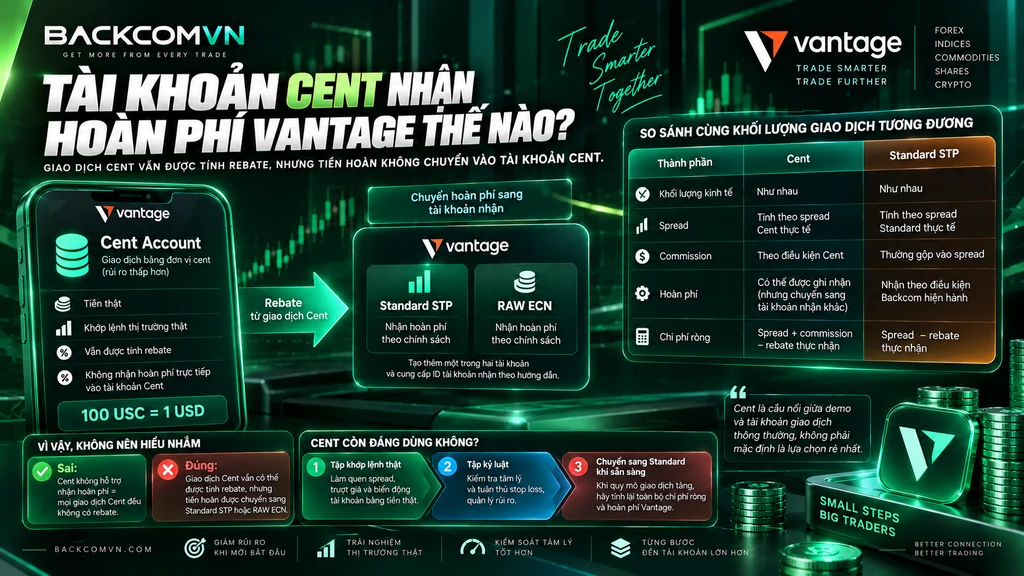
The distinction to make is that a Cent account does not receive the rebate into the Cent account itself. Under Backcom’s current policy, Cent trades can still be recorded for a rebate, but the user needs an additional Standard STP or RAW ECN account to act as the receiving account.
So “Cent does not support rebates” should not be read as every Cent trade earning zero. These are two separate questions:
- Whether a trade is recorded for a rebate at all: that depends on the IB policy and the instrument traded.
- Where the money is paid: with Cent, it is not credited directly to the Cent account.
- To receive it: you need to open a Standard STP or RAW ECN account and supply the receiving account ID as instructed.
Check the Vantage rebate by instrument immediately before trading, because the rate and the conditions can change with the account type, the instrument and partner policy.
Comparing on the same volume: Cent against Standard STP
The most common mistake is to read the lot figure on a Cent account and place it straight beside a Standard lot figure. Two identical numbers on screen do not necessarily represent the same economic volume, because Cent uses a smaller contract size. To compare costs properly, convert both to the same equivalent trading volume first, then apply: net cost = spread + commission − rebate actually received.
| Component | Cent | Standard STP |
|---|---|---|
| Economic volume | Equal | Equal |
| Spread | Based on the actual Cent spread | Based on the actual Standard spread |
| Commission | Per Cent conditions | Usually built into the spread on Standard STP |
| Rebate | May be recorded but paid to a separate receiving account | Received according to the applicable conditions |
You cannot conclude that Cent is more expensive merely because the rebate does not land in the Cent account. To know which side is cheaper, take the actual spread, the equivalent volume and the Vantage rebate actually received on the same instrument, and put them side by side. This is also why you should not take a 0.01 Cent lot order and compare it directly with 0.01 Standard STP lots. The lot numbers match, but the amount of money exposed to market movement can be very different.
So is Cent still worth using?
Yes, but the advantage of a Vantage Cent account does not lie in it reliably producing the lowest cost. Cent is most useful when you want to move from a demo to real money without committing a large amount to each trade. A few dollars of profit or loss feels very different from a demo account with a notional balance of tens of thousands.
It helps to view a Cent account in three stages. First, practise real execution: get used to spreads, slippage and the movement of a real balance. Second, practise discipline: check whether you still respect your stop loss, your position size and your risk limits while real money is moving. Third, move to Standard STP or RAW ECN: once volume rises and the differences in spread, commission and rebate start to outweigh the amount you were trying to limit with Cent.
In other words, treat Cent as a bridge between a demo and an ordinary trading account, not as the cheapest option by default. When volume rises, recalculate the whole net cost and the Vantage rebate rather than staying on Cent because you are used to the interface and the way the balance is displayed.
How a swap-free account works
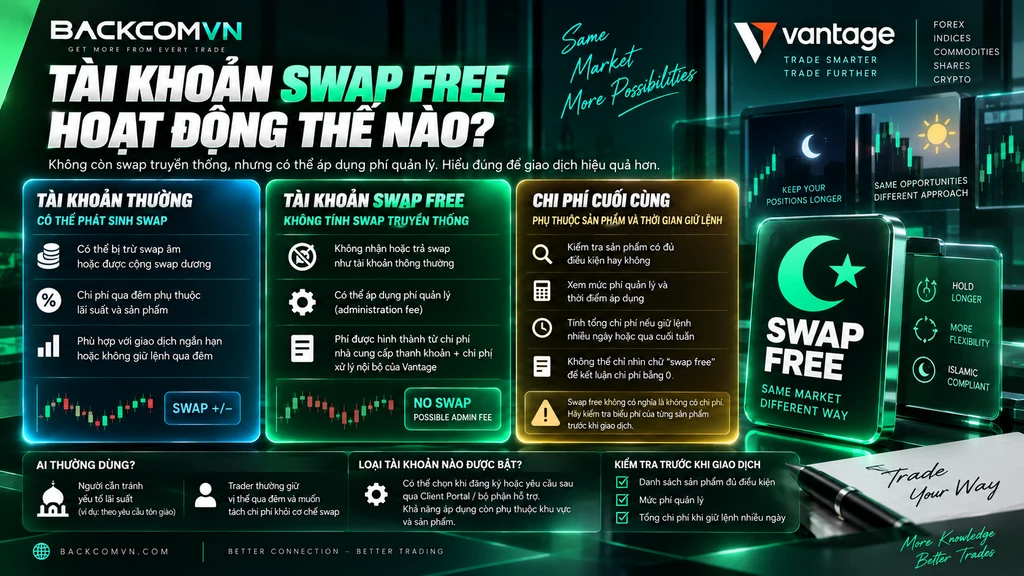
A swap-free account does not mean every cost of holding overnight disappears. Vantage removes traditional swap on eligible accounts, but may instead apply an administration fee charged directly against the balance. Put briefly: the mechanism for charging overnight costs changes, not the fact that holding a position has a cost.
According to Vantage’s Swap Free account documentation, the account does not receive or pay swap the way an ordinary account does. Eligible positions may instead incur an administration fee, and Vantage confirms that this fee is made up of the liquidity provider’s cost plus internal processing costs. That creates an important distinction:
- Ordinary account: an overnight position may be debited a negative swap or credited a positive one.
- Swap-free: no swap arises under that mechanism, but an administration fee may be charged.
- Final cost: you have to look at the fee schedule for each instrument and the holding period — the words “swap free” are not enough.
Who normally uses a swap-free account?
The first group is people who need to avoid trading with an interest component for religious reasons, particularly in Islamic finance. Vantage states this purpose directly when describing the product.
The second group is traders who regularly hold positions overnight and want to separate cost from a variable swap mechanism. A swap-free account is not cheaper by default, however. If the administration fee accumulates, the total cost of a position held for several days can still be significant. Before choosing this type, check three things: whether the instruments you trade are on the eligible list, how the administration fee is calculated and when it starts, and what the actual total fee comes to if you hold for several days or over a weekend.
Which account types can have swap-free enabled?
Vantage currently describes Swap Free as an account type or option for eligible clients. Its updated guidance indicates that a user can select the swap-free option at registration or request it later through the Client Portal or support, with availability still depending on region and instrument.
So do not assume that holding a Vantage account automatically exempts every instrument from swap. The safest approach is to check your account status and the list of eligible instruments on Vantage’s Swap-Free account page before opening an overnight position. More importantly, the phrase “swap free” only tells you that traditional swap has been removed. To know what an overnight position really costs, you still have to calculate the administration fee that replaces it — which is what decides the cost in the next section.
The administration fee that replaces swap
On an ordinary account, the Vantage overnight charge can be a debit or a credit, depending on the instrument and whether the position is long or short. On a swap-free account, that swap is replaced by an administration fee debited from the balance. Vantage states that the administration fee comprises costs applied by the liquidity provider plus internal processing charges, so the level can change.
This is the key point: swap-free changes the charging mechanism; it does not mean the total cost of holding a position is always zero. Vantage’s current Client Agreement also provides that a Swap Free account incurs an administration fee in place of a Swap Charge when a position is held overnight.
Suppose you open one lot of EURUSD and hold it across five rollovers. The correct way to compare is to take the current swap for that exact instrument and direction on an ordinary account, and set it against the expected total administration fee on a swap-free account. One caveat recorded on 18/09/2026: Vantage does not publish a fixed EURUSD administration fee on its current Help Center that would be reliable as a long-term benchmark, and the company states the fee tends to move with liquidity provider costs. A hard-coded table saying “one week = X USD” can therefore become wrong quickly.
If you are not clear on how ordinary swap is formed and credited or debited, see our article on what the overnight swap charge is and why Wednesday is charged three times. It is also one of the items set out in our full guide to forex trading costs, and one of the easiest to miss when you look only at the spread.
Three common traps with swap-free accounts
There are three mechanisms to check before assuming swap-free is certainly cheaper. These are general market warnings; not all three are confirmed as applying at Vantage.
- Grace period: some brokers waive charges for the first few days and only then start the administration fee. There is currently no sufficiently clear first-party source confirming that Vantage applies a fixed grace period, so do not assign a number of days to the broker yourself.
- The administration fee can change the comparison: on an ordinary account there are cases of positive swap, where the trader is credited. Switching to swap-free means you no longer receive that credit and an administration fee may arise instead. Compare final costs, not the names of the charges.
- Spread or other conditions may offset the cost at some brokers: this is a market mechanism to watch for, but Vantage’s own documentation currently states that Swap Free has the same trading conditions as an ordinary account except for the swap and administration fee mechanism. There is no basis for claiming Vantage quietly widens spreads on Swap Free.
Before a trade you expect to hold for several days, then, take the current swap for the exact instrument and direction and place it beside the total administration fee on a swap-free account. Only that calculation shows which option costs less.
When to choose each, and when to go back to Standard STP
A Vantage Cent account and a swap-free account solve two different problems. Cent reduces the scale of real money while you are learning to trade; swap-free suits a user who needs to remove the swap mechanism. But as volume rises or holding periods lengthen, it is spread, the administration fee and the Vantage rebate that belong on the scales.
If your main aim is to practise psychology with real money, Cent has a reason to exist. Once you can hold your risk steady and start increasing volume, recalculate cost on the same economic volume rather than staying on Cent because the balance and the lot numbers look smaller.
With a swap-free account the decision depends far more on the holding period. A position held across a couple of rollovers and one held for several weeks can produce entirely different cost outcomes. Take the ordinary-account Vantage overnight charge and the expected total administration fee on swap-free and compare them directly before opening.
Frequent traders should pay additional attention to the rebate. Once the Vantage rebate is large enough to affect net cost clearly, Standard STP may deserve more consideration than staying on Cent purely to keep the contract size small. Standard STP and RAW ECN are treated separately in our article on Vantage Standard STP or RAW ECN, so there is no need to repeat that calculation here.
Check the legal entity before you deposit
Vantage operates through several legal entities, and the legal documents that apply to an account depend on the entity the user actually registered with. Vantage’s international-market page currently states that accounts opened through it may sit with Vantage Global Limited, regulated by the VFSC in Vanuatu, rather than automatically with an FCA-regulated entity.
So do not rely on a logo or a brand name. Check the entity name in your own Client Agreement, then verify it with the corresponding regulator. You can also look up Vantage Global Prime LLP on the FCA’s Financial Services Register, and read our comparison of FCA, ASIC and CySEC to understand how the licences differ.
In summary: Cent suits you when your biggest problem is the scale of your risk, and swap-free suits you when your biggest problem is the swap mechanism. When neither is a priority any more, go back to the net-cost calculation and see whether an ordinary account makes more sense.
Frequently asked questions
Does a Vantage Cent account earn a rebate?
A Vantage Cent account does not receive the rebate directly into the Cent account. As for whether Cent volume is recorded so the rebate can be paid to a Standard or RAW ECN account, the publicly available information is not entirely consistent at present. Check the current Vantage rebate policy before trading large volume.
What is a cent account, and does it differ from a demo?
A cent account still uses real money, but the balance and the trade size are expressed in cents. A demo uses simulated money, while Cent produces real profits and losses. Cent therefore suits you better when you want to practise psychology with a small amount of real risk.
Is holding overnight on a swap-free account really free?
A swap-free account should not be read as holding positions overnight at no cost. Vantage removes the traditional swap credit and debit mechanism but may apply an administration fee instead. To know the real cost, check the administration fee for the exact instrument rather than noting that the Vantage overnight charge is zero.
Conclusion
A Vantage Cent account suits you best when you need a step from a demo to real money: a smaller trading scale lets you practise psychology and discipline without facing large swings from the outset. Once you trade regularly, however, re-examine the Vantage rebate mechanism and convert all costs to the same economic volume rather than assuming Cent is always cheaper.
With a swap-free account, the most important point is not to equate “no swap” with “no cost”. Vantage replaces the traditional swap mechanism with an administration fee where it applies, so anyone holding for several days still needs to add that charge in full before deciding. To summarise: Cent suits practising with real money at a small scale; swap-free suits removing the swap credit and debit mechanism, but the administration fee still has to be checked; and frequent traders should recompare spread, commission, rebate and holding costs before deciding whether to stay on Cent or move to an ordinary account.
If you already use Vantage, you can review the Vantage rebate table and current conditions before opening an account or increasing your trading volume.
This content on backcomvn.com is for information only and is not investment advice. Forex and CFDs are leveraged products that can cause you to lose money rapidly. Account conditions, spreads, swaps, administration fees and rebate policies can change by time, instrument and the legal entity serving the client. Check the details directly with Vantage before making a trading decision.
The Backcom VN editorial team
The Backcom VN editorial team tracks forex trading costs: the fee schedules, rebate levels and licences of eight brokers, together with the market figures that feed into the cost of each trade. Every number we publish carries a public source and the date it was accessed, so you can check it yourself.
Related articles

Forex broker rebates compared, instrument by instrument
Four brokers' rebate rates side by side on the same instruments in the same unit, USD per lot. Gold ranges…

What the spread is, and how to read it on the platform
Platforms show the spread in points, not pips: a spread of 12 on EUR/USD is 1.2 pips, roughly $12 per…

Overnight financing (swap), and why Wednesday is charged three times
Swap comes from the interest-rate difference between the two currencies, plus the broker's own markup. Wednesday night is tripled by…

What one lot of gold actually costs to trade
Convert spread into money, add commission in the same units, and find out why two traders on the same instrument…

ECN or Standard: the calculation that decides your account type
ECN is not automatically cheaper - it only moves the cost out of the spread. How to convert both to…

Forex in 2026: leverage tightening, and where the real cost sits
The move towards 1:30 leverage, cross-border geofencing making brokers responsible for the source of funds, and the bonus ban in…