
 The Backcom VN editorial team
33 min read

In this article7
- Which XM account types a Vietnamese trader can open
- Micro and Standard differ in exactly one thing
- Ultra Low: a lower spread, but three trade-offs
- Spread against rebate: the calculation changes by instrument
- The XM rebate goes to My Wallet, not straight to the account
- Frequently asked questions about XM account types
- Conclusion
Last updated: 18/09/2026
Among the XM account types, Standard and Ultra Low are the two that most often leave a trader undecided: the Ultra Low account has a markedly lower spread, but the XM rebate is lower too and some of the benefits that come with Standard no longer apply. Looking only at the spread to decide which is cheaper can therefore lead to the wrong choice.
In this article, backcomvn.com places the spread you save next to the rebate and benefits you give up, instrument by instrument, so you can see whether Standard or Ultra Low fits the way you actually trade.
Contents
- Which XM account types a Vietnamese trader can open.
- Micro and Standard differ in exactly one thing.
- Ultra Low: a lower spread, but three trade-offs.
- Spread against rebate: the calculation changes by instrument.
- The rebate goes to My Wallet, not straight to the account.
- Frequently asked questions and conclusion.
Which XM account types a Vietnamese trader can open
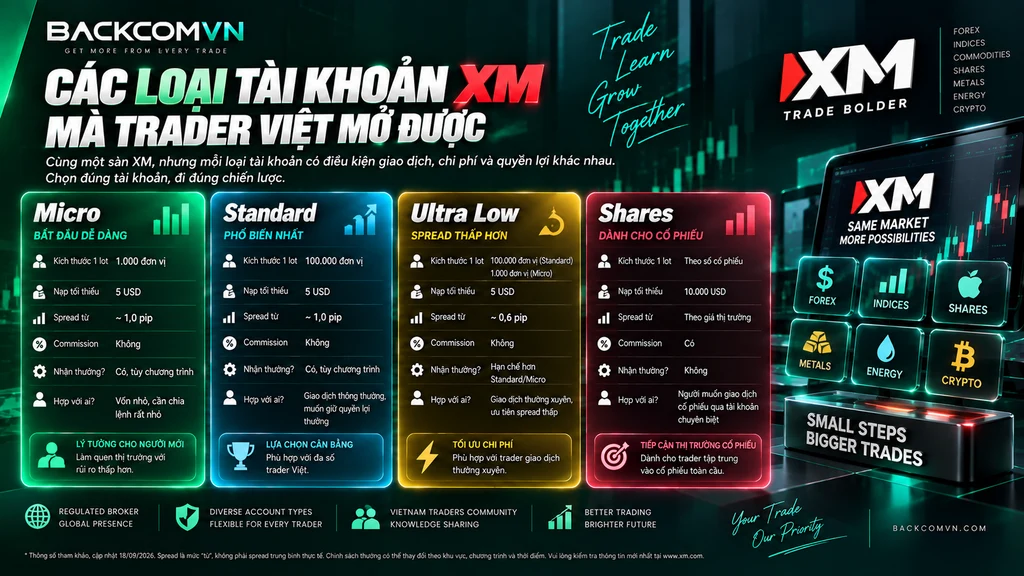
If you open an account under XM’s international entity — XM Global Limited, licensed by the FSC in Belize, covered in detail in our XM broker review — what you need to distinguish is not just the name but the lot size, the spread, the bonus policy and how charges are calculated. Check the latest figures on XM’s official account types page before registering.
| Account type | Size of 1 lot | Minimum deposit | Reference spread from | Commission | Bonus eligible?* | Who it suits |
|---|---|---|---|---|---|---|
| Micro | 1,000 units | 5 USD | About 1.0 pip | None | Yes, programme dependent | Small capital, needs very small position sizes |
| Standard | 100,000 units | 5 USD | About 1.0 pip | None | Yes, programme dependent | Ordinary trading, wants to keep bonus benefits |
| Ultra Low | 100,000 units on the Standard version; 1,000 units on the Micro version | 5 USD | About 0.6 pips | None | More limited than Standard and Micro | Frequent trading, prioritises a low spread |
| Shares | Per number of shares | 10,000 USD | Per market price | Yes | No | Traders who want share dealing through a dedicated account |
Reference figures recorded 18/09/2026. Spreads in the table are “from” levels, not actual average spreads. Bonus policy can change by region, programme and time.
The most notable point is that Micro, Standard and Ultra Low charge no commission on forex trades under the current fee structure, so the direct cost sits mostly in the spread. Sources updated for 2026 also record Micro and Standard with published spreads from about 1.0 pip on EUR/USD, and Ultra Low from about 0.6 pips.
On trading cost alone, then, the Ultra Low account has a fairly clear initial advantage. But that is not the whole calculation: Standard and Micro can be eligible for bonus or loyalty programmes that Ultra Low is not. That difference is converted into money later in this article rather than concluding that “a lower spread must be cheaper”. Shares is a different case entirely: XM currently publishes a 10,000 USD minimum deposit for it, so it is not a direct comparison with Standard or Ultra Low for most forex traders.
XM Zero: why you read about it elsewhere but may not see it in your own account
XM Zero is the clearest example of why you should not take one entity’s account table and apply it to every country. XM’s European account page can still display Zero with spreads from 0 pips and a fixed commission, while the page for XM Global Limited displays Standard, Ultra Low and Shares.
The reason is the regulating entity. XM Global Limited is currently supervised by the Financial Services Commission (FSC) of Belize under the Securities Industry Act 2021, while clients in the EEA are served by the Cyprus entity. You can check this directly on XM’s licence page.
So when reviewing XM account types, check the type that actually appears in your registration and the entity named in your terms of service, rather than assuming XM Zero is always available. For this article, the cost comparison for Vietnamese traders focuses on Micro, Standard and Ultra Low; Shares is kept in to complete the picture but is not a direct competitor to the two main options.
Micro and Standard differ in exactly one thing
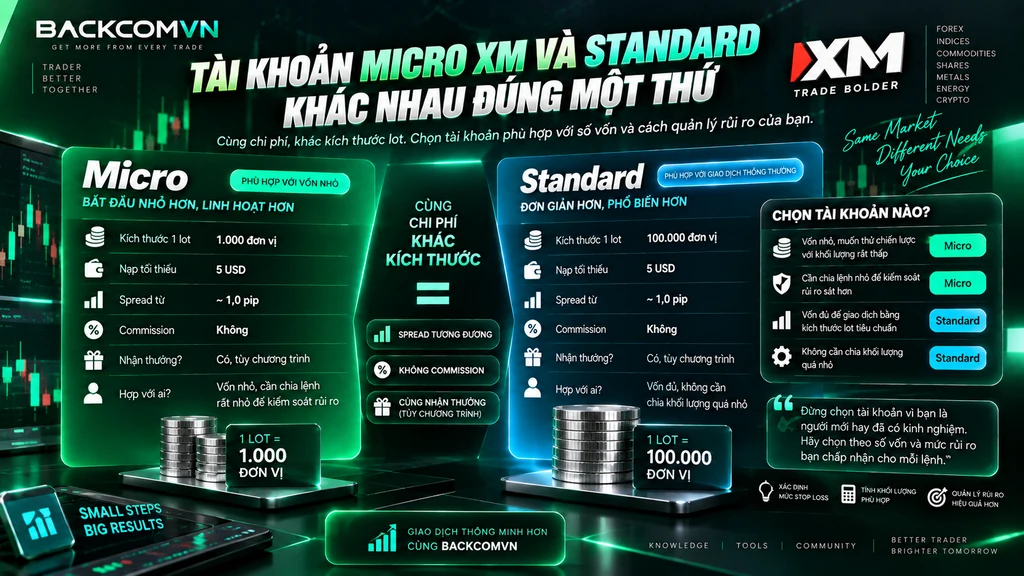
Micro and Standard share the same basic cost structure: an equivalent spread, no commission on forex, and the same focus on ordinary CFD trading. The important difference is lot size: one Micro lot is 1,000 units of the base currency, while one Standard lot is 100,000 units.
In other words, this is not a choice between a “cheap” and an “expensive” account. The spread is not the deciding factor between these two; the real question is how finely you need to divide your volume in order to control risk.
Choose by capital, not by experience level
The more sensible approach starts from the amount you accept losing if a trade hits its stop loss. If you are looking for an appropriate capital level before opening an account, see our guide to how much capital you need to start trading forex.
For example, if each trade may only risk 1% of the account but the required volume is smaller than what you can comfortably place on Standard, Micro is more flexible. Conversely, if the calculated volume already falls within standard lot territory, Standard creates no disadvantage in spread or commission merely because the account has a different name.
| Scale and trading need | More suitable type |
|---|---|
| Small capital, testing a strategy at very low volume | Micro |
| Needs small position sizes for closer risk control | Micro |
| Enough capital to trade in standard lot sizes | Standard |
| No need to divide volume very finely | Standard |
The important point is not to pick Micro simply because you are new, nor Standard simply because you have traded for a long time. Before each trade, set your stop loss and the amount you accept risking, then calculate position size from that risk before deciding on the account type. If Micro and Standard are the two you are weighing, the question should be: do I need to divide volume more finely? If yes, Micro is more practical; if no, Standard is simpler and keeps the same basic cost structure.
Ultra Low: a lower spread, but three trade-offs
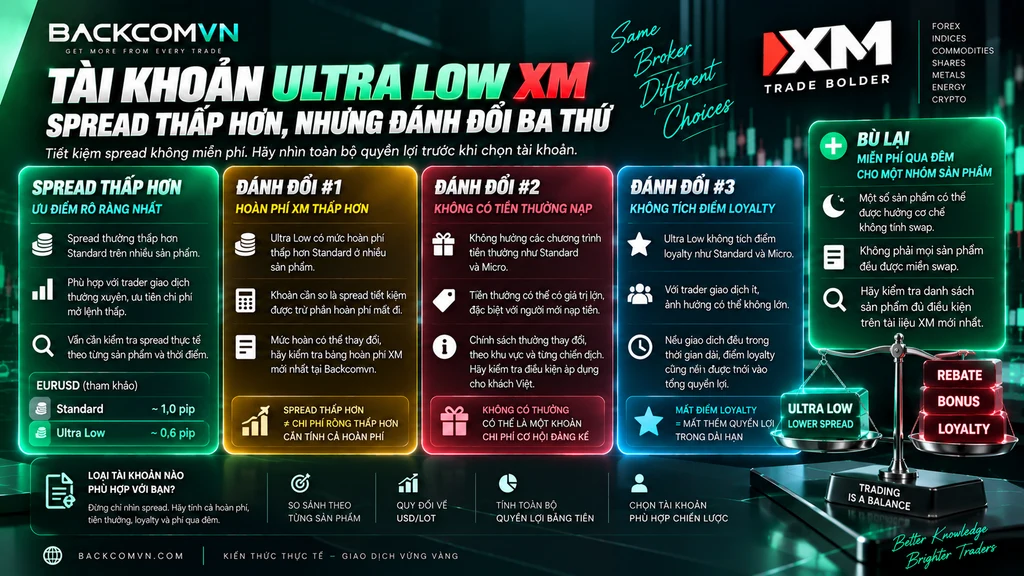
The Ultra Low account is attractive for the most visible reason: a lower spread than Standard on many instruments. That saving is not free, however. In exchange, a trader may receive a lower XM rebate, may not qualify for some bonus programmes and does not accumulate loyalty points the way Standard or Micro does. On spread alone, Ultra Low usually looks cheaper. Convert all the benefits into money and the gap can be considerably smaller.
A lower share of the XM rebate
This is the item to calculate first, because it accrues with trading volume, just like the spread. Under the rebate mechanism Backcom VN tracks, Ultra Low has a lower rate than Standard on many instruments. Check the XM rebate by instrument at the time of trading, because rates can change and the gap is not the same for gold, major pairs and other instruments.
The way to think about it: Standard has a wider spread but receives a higher rebate; Ultra Low saves on the spread as soon as you open and close but receives less back. What has to be compared is not the spread in isolation but the spread saved minus the rebate given up. That is why no general conclusion that Ultra Low is always cheaper than Standard is possible.
No deposit bonus as on Standard and Micro
The second trade-off is the bonus programme: Ultra Low does not receive the same bonus benefits as Standard and Micro. This matters particularly for someone opening an account or funding for the first time. A spread is a cost repeated on every trade, while a bonus is usually a benefit tied to a programme and a point in time. In the early stage, then, the value of a bonus can exceed the amount saved on spread.
Do not put a fixed bonus rate into the calculation without checking the programme currently applying to clients in Vietnam, however. This policy can change by region and by campaign.
No loyalty points
Loyalty points are also part of the opportunity cost of choosing Ultra Low. XM’s loyalty programme is designed for eligible account types such as Standard and Micro, while Ultra Low does not carry the same benefit. For someone who trades rarely the value given up may be small, but if you trade steadily over a long period, accumulated points should be counted alongside the rebate and the bonus rather than ignored altogether.
The three Ultra Low trade-offs can be summarised as: a lower rebate on many instruments; no equivalent bonus benefits to Standard and Micro; and no loyalty points under the mechanism available to eligible accounts.
In return: no overnight charge on a group of instruments
Ultra Low also has an advantage that intraday-only traders easily overlook: some instruments can qualify for a no-swap arrangement. If you regularly hold overnight, this item can matter more than the difference in spread or rebate. To understand the charge being removed, see our article on what the overnight swap charge is.
Do not read Ultra Low as swap-free on every instrument, however. The list of eligible instruments needs to be checked against XM documentation and reviewed periodically. Hold an instrument outside the list and an overnight cost can still arise. Ultra Low therefore has a clear advantage for anyone who prioritises a low spread or who regularly holds instruments in the swap-exempt group. Standard, conversely, may deserve more consideration if the higher XM rebate, the bonus and loyalty benefits make up the spread difference.
Spread against rebate: the calculation changes by instrument
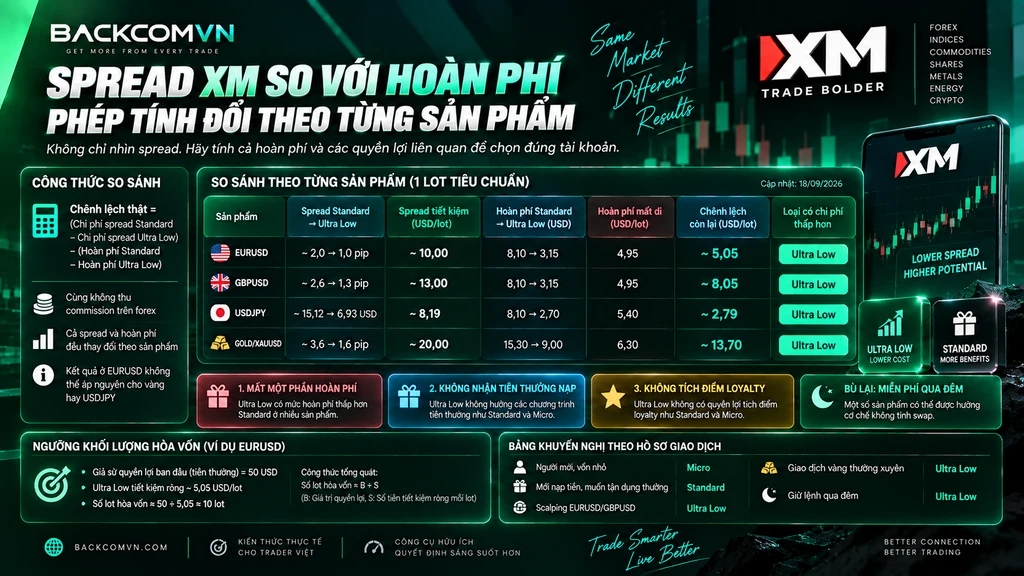
To compare Standard with Ultra Low, do not put the spread or the rebate on the scales on its own. The formula to look at is:
Real difference = (Standard spread cost − Ultra Low spread cost) − (Standard rebate − Ultra Low rebate)
XM charges no separate commission on these two account types, so the calculation is relatively easy to read. Both the spread and the rebate vary by instrument, though; a result for EURUSD cannot be applied unchanged to gold or USDJPY.
Does the spread saved cover the rebate given up?
The table below uses average or reference spreads near the update date, converted to the cost of one standard lot. Rebates are shown per instrument so you can see how much more Standard receives than Ultra Low.
| Instrument | Spread Standard → Ultra Low | Spread saved | Rebate Standard → Ultra Low | Rebate given up | Remaining difference | Lower cost* |
|---|---|---|---|---|---|---|
| EURUSD | ~2.0 → 1.0 pip | ~10.00 USD/lot | 8.10 → 3.15 USD | 4.95 USD | ~5.05 USD/lot | Ultra Low |
| GBPUSD | ~2.6 → 1.3 pip | ~13.00 USD/lot | 8.10 → 3.15 USD | 4.95 USD | ~8.05 USD/lot | Ultra Low |
| USDJPY | ~15.12 → 6.93 USD spread cost | ~8.19 USD/lot | 8.10 → 2.70 USD | 5.40 USD | ~2.79 USD/lot | Ultra Low |
| GOLD/XAUUSD | ~3.6 → 1.6 pip | ~20.00 USD/lot | 15.30 → 9.00 USD | 6.30 USD | ~13.70 USD/lot | Ultra Low |
Reference data recorded 18/09/2026. These are floating spreads and can widen with liquidity, the trading session or news. Rebate rates can also change with partner programmes — check the current table before placing an order.
The table makes one point fairly clear: a higher XM rebate on Standard does not automatically make Standard cheaper. On EURUSD, Standard receives about 4.95 USD more rebate per lot, but also pays about 10 USD more in spread cost in this reference calculation. Netting the two sides, Ultra Low still saves roughly 5.05 USD per lot. With gold the gap is wider in this data: the spread saved is about 20 USD per lot while the rebate given up is about 6.30 USD, so the net difference still favours Ultra Low by roughly 13.70 USD per lot.
This also explains why you should not choose between XM account types on a single number. A low spread is a real advantage and a high rebate is a real advantage; only by converting both to USD per lot do you find out which is larger. For the Micro account, do not apply the standard USD-per-lot figures from the table directly: Micro has a smaller contract size, so the conversion has to follow the actual contract size and volume.
The volume threshold that reverses the conclusion
A bonus differs from spread and rebate in one important respect: a bonus is usually a capped or programme-specific benefit, while spread and rebate repeat on every lot.
Suppose that at the time you open the account, the total value of the benefits you can genuinely use on Standard is worth 50 USD. If you trade EURUSD and Ultra Low saves about 5.05 USD per lot net, as in the table above: 5 lots saves about 25.25 USD; 10 lots saves about 50.50 USD; 20 lots saves about 101 USD. In this example, then, after roughly 10 lots the trading cost saved already matches the original 50 USD of benefits.
This is only a way of locating the threshold, not a fixed figure for every account. If the bonus value is B and Ultra Low saves S USD per lot net, the threshold is simply: break-even lots ≈ B ÷ S. The more often you trade, therefore, the more the repeating cost matters. That is also why asking only which broker has the lowest spread is not enough; you need net cost after the rebate and the related benefits.
Recommendations by trading profile
No single account type is cheapest in every case. But placing the way you actually trade next to the cost structure makes the choice clearer.
| Trading profile | Volume or characteristic | Type to prefer | Main reason |
|---|---|---|---|
| New, small capital, needs very small position sizes | Low volume | Micro | Easier to control trade size; no need to chase a low spread at all costs |
| Just funded and wants to use a bonus programme | Low to moderate volume | Standard | The initial benefit can outweigh the spread saved in the early stage |
| Scalping EURUSD or GBPUSD frequently | High volume | Ultra Low | A low spread repeats on every trade; the saving can exceed the rebate given up |
| Trading gold frequently | Moderate to high volume | Ultra Low | The spread difference on gold can exceed the rebate difference |
| Holding major pairs or gold across several nights | Not necessarily many lots | Ultra Low | Beyond the low spread, the free-swap benefit on eligible instruments also counts |
The key is that Standard suits you better when you genuinely use the benefits that come with it, while Ultra Low has the clearer advantage once cost repeating with volume becomes the priority. Before choosing an account, then, take the instrument you actually trade and work out three lines: the spread you pay, the rebate you receive back, and swap if you hold overnight. With those three numbers in one table, choosing between Standard and Ultra Low is far more realistic than looking at an advertised spread on its own.
The XM rebate goes to My Wallet, not straight to the account
One point beginners easily miss is that the XM rebate is not necessarily credited directly to the balance of the account you trade on. The money is recorded in My Wallet, from where you can transfer it internally to the appropriate account. Platform login is covered separately in our guide to logging in to XM on MT4 and MT5.
Separating the two has the advantage of making it easier to reconcile the rebate against trading profit and loss, but it does add one more balance-management step. If you are not familiar with the mechanism, see our guide to XM paying the rebate into My Wallet — what changes and what to watch, rather than confusing the wallet balance with the equity of your MT4 or MT5 account.
For the purpose of comparing Standard and Ultra Low, what matters is to count the rebate in your net cost even while the money sits in My Wallet. The fact that it has not yet been transferred to the trading account does not change its economic value.
Which entity is serving you, and why that matters more than the account type
Before choosing Standard or Ultra Low, check the entity named in your own account terms. The same XM brand can cover entities under different supervision, offering different account ranges and applying different client protections.
One licence often mentioned in connection with XM is CySEC 120/10. CySEC’s own record confirms that Trading Point of Financial Instruments Ltd was granted licence number 120/10 on 05/08/2010 in Cyprus, and you can verify this yourself in the CySEC list of licensed investment firms.
That licence should not be assumed to be the entity applying to every XM account, however. On its regulation page for international markets and on its current Vietnamese-language page, XM states that XM Global Limited is supervised by the Financial Services Commission of Belize under the Securities Industry Act 2021, with licence number 8557558. This can also be checked independently on the FSC Belize register. At the time of checking in September 2026, the FSC database listed XM Global Limited as registered for dealing in and arranging deals in securities, with a registration period from 01/01/2026 to 31/12/2026.
Verifying it in practice takes three steps: open the legal terms or account information in the XM members area; record the full entity name, not just the brand name “XM”; then search for that exact name on the relevant regulator’s register. This matters because a licence held by one company in a group does not automatically become the licence protecting an account at a different entity. To understand how the supervisory systems differ, read our comparison of FCA, ASIC and CySEC.
Before weighing spread or rebate between Standard and Ultra Low, then, confirm exactly which company is contracting with you. The account type determines how you pay trading costs; the entity determines the legal framework that account operates inside.
Frequently asked questions about XM account types
Is the XM Ultra Low account really cheaper than Standard?
Not in every case. Ultra Low has the spread advantage, but Standard usually has a higher XM rebate and may come with additional bonus benefits. The most accurate approach is to take the spread saved minus the rebate given up for the instrument you actually trade, as in the table above.
How does the XM Micro account differ from Standard?
The important difference is contract size. Micro uses a much smaller lot than Standard, which lets a trader with limited capital divide volume and control risk more flexibly. This is mainly a decision about trade size, not a choice between two entirely different spread or commission structures.
Which XM account type earns the highest rebate?
Do not choose on the highest rebate alone. According to the XM rebate table used in this article, Standard receives a higher rate than Ultra Low on many instruments, but Standard also has a wider spread. A larger rebate only means something when the total net cost, after the spread, is still lower.
I use Standard — can I switch to Ultra Low?
You do not convert the type of an existing Standard account to Ultra Low; you open an additional Ultra Low account within the same client profile. That also lets you keep Standard and Ultra Low in parallel for different strategies or instruments.
Conclusion
Among the XM account types, there is no single cheapest choice between Standard and Ultra Low for every trader. XM charges no separate commission on these two, so cost sits mostly in the spread; but the lower Ultra Low spread has to be set against a lower XM rebate, more limited bonus eligibility and the loss of loyalty benefits available on Standard.
If you trade frequently, particularly in instruments with a large spread difference, Ultra Low can save a meaningful amount of repeating cost. Standard still deserves consideration if you genuinely use the higher rebate, the bonus programme and the accompanying benefits.
Most importantly, do not choose an account on a single advertised number. Take the instrument you trade, compare the actual spread, the rebate received and swap if you hold overnight, then convert everything to the same USD-per-lot basis. You can check current rates in the XM rebate by instrument before deciding. Finally, confirm which entity serves your account before you deposit: the account type determines how you pay trading costs, while the entity determines the legal framework that account operates inside.
This content on backcomvn.com is for information and cost comparison only, and is not an investment recommendation or an invitation to trade. Forex and CFDs are leveraged products that can cause you to lose money rapidly. Account specifications, spreads, rebates, swaps, bonus programmes and legal conditions can change by time, region and entity. Check the details directly with XM and assess how suitable they are for your financial circumstances before trading.
The Backcom VN editorial team
The Backcom VN editorial team tracks forex trading costs: the fee schedules, rebate levels and licences of eight brokers, together with the market figures that feed into the cost of each trade. Every number we publish carries a public source and the date it was accessed, so you can check it yourself.
Related articles

Spread markup: where the biggest rebates come from
One sign-up route can pay three times the rebate of another — because the markup funding it is added to…

The real cost of scalping, measured in pips
Seven dollars a lot sounds small until you pay it 200 times a month. Convert the cost into pips and…

What EUR/USD actually costs per lot
Standard $11 a lot, Raw $8. But the rebate can reverse the order — the right comparison is net cost…

The cost of trading USD/JPY, and the swap trap
USD/JPY has a cheap spread but a heavy negative swap on the short side. One lot short for 20 days…

Overnight financing on multi-day gold positions
Gold charges negative swap in both directions. Holding one lot for two weeks can cost over $500 — about $5…

Is a swap-free account really free?
Swap-free removes overnight financing but recovers it through a wider spread, a daily administration fee, or excluded instruments. How to…