
 The Backcom VN editorial team
18 min read

In this article8
To calculate index CFD costs, convert the spread into money, add commission, financing for the time you hold the position and currency conversion differences, then subtract any eligible rebate. This guide explains how to read contract specifications, calculate each component and compare costs at the same trading size. All examples use assumed figures; the value of one point per lot varies between brokers.
Last updated: 06/11/2026.
What makes up index CFD costs?
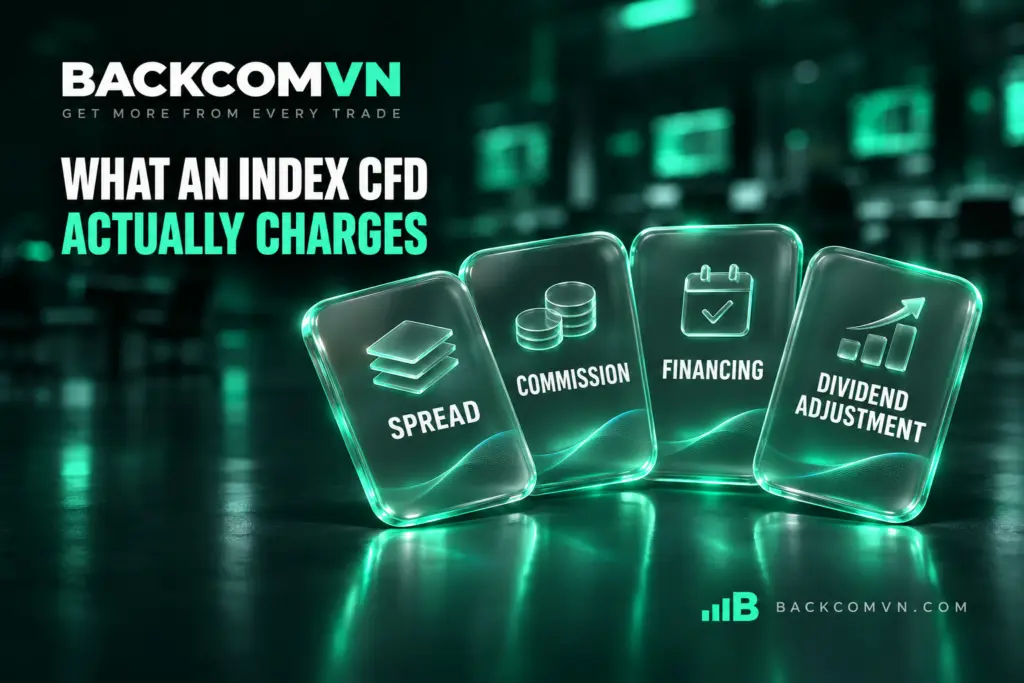
These costs are the combined price differences and charges incurred when opening, holding and closing an index CFD position, after allowing for eligible rebates. The components to check are the spread, commission, overnight financing and currency conversion. Dividend adjustments also need checking, but should be reconciled separately from those charges.
| Component | When it arises | Where to check the specifications |
|---|---|---|
| Spread | When trading at different buy and sell prices | Bid/Ask quotes and the product’s spread information |
| Commission | On opening or closing a trade, if applicable to the account | The commission schedule and charging rules for each side |
| Financing | When a position crosses the charging cut-off | The financing, overnight funding or swap section |
| Currency conversion difference | When an amount is converted into the account currency | Currency conversion terms and statements |
| Dividend adjustment | When a spot product has an adjustment event | The dividend calendar and rules for each position direction |
| Rebate | When the product, account and trade meet the eligibility conditions | The list of eligible products and reconciliation schedule |
Use a consistent sign convention when adding up index CFD costs: a debit increases the cost, while a credit reduces it. A dividend adjustment is not automatically a service fee. Record it separately so that you can distinguish it from financing and avoid counting the same amount twice when reviewing a statement.
For a systematic approach to the calculation, see how to calculate the total cost of a trade. For the relevant product group, this guide to trading US indices: S&P 500, Nasdaq and Dow puts contract specifications into the context of the index you are following.
The value per point: where calculations can go wrong

Tracking the same index does not mean that contracts have the same size. Similar-looking symbols can use different lot definitions, price increments and settlement currencies. The value per point for one lot therefore varies between brokers. Do not carry specifications from a previous account into a new account without checking the contract details.
In MT4/MT5, open Market Watch, select the symbol and open Specification or the equivalent contract information panel. Look for contract size, tick size, tick value, profit currency and volume step. If a necessary field is missing, consult the product documentation before calculating the monetary value of the position.
Distinguish an index point from the “point” a platform uses to describe quote precision. A tick is the smallest price movement; it does not automatically equal one index point. If tick value is stated for one lot, divide that value by the tick size expressed in index points to find the value per index point.
Suppose one tick equals 0.1 index points and is worth USD 0.20 per lot. The value per point is then 0.20 ÷ 0.1 = USD 2 per lot. Suppose you trade 0.5 lots: each point of movement represents USD 1. If you mistakenly enter 5 lots, that becomes USD 10, or ten times as much.
A unit error distorts both the monetary spread calculation and the financing calculation. Before comparing index CFD costs, write down which kind of point you are using, how many lots the point value represents and the currency of the result. These details establish a consistent basis for every calculation that follows.
Converting the index spread into money
The conversion formula is: spread cost = spread in index points × value per point per lot × number of lots. Measure the spread using the difference between Ask and Bid at the same moment. Combining a buy quote from one time with a sell quote from another does not give a consistent spread measurement.
Suppose the spread is 2 points, the value per point is USD 2 per lot and the position size is 0.5 lots. The monetary spread cost is 2 × 2 × 0.5 = USD 2. These are assumed figures for illustration; the value per point for one lot varies between brokers.
When estimating the cost of opening and closing a trade, avoid automatically doubling a spread calculated this way. This simplified calculation assumes comparable quote conditions; the actual spread at exit may differ. When reconciling completed trades using execution prices, also avoid deducting the spread again when it is already reflected in those prices.
Spreads can widen outside the main session or around macroeconomic news. To measure index CFD costs in a way that reflects your trading habits, record Bid, Ask and the time during your usual trading window. Keep observations from normal market conditions separate from news periods, rather than treating the lowest observed spread as representative.
The quoted price difference may involve a spread markup. If the account also charges a separate fee, review how commission is calculated and establish whether the published amount applies to each side or to the complete opening and closing cycle. A smaller spread alone does not establish a lower total cost.
Overnight financing on an index CFD
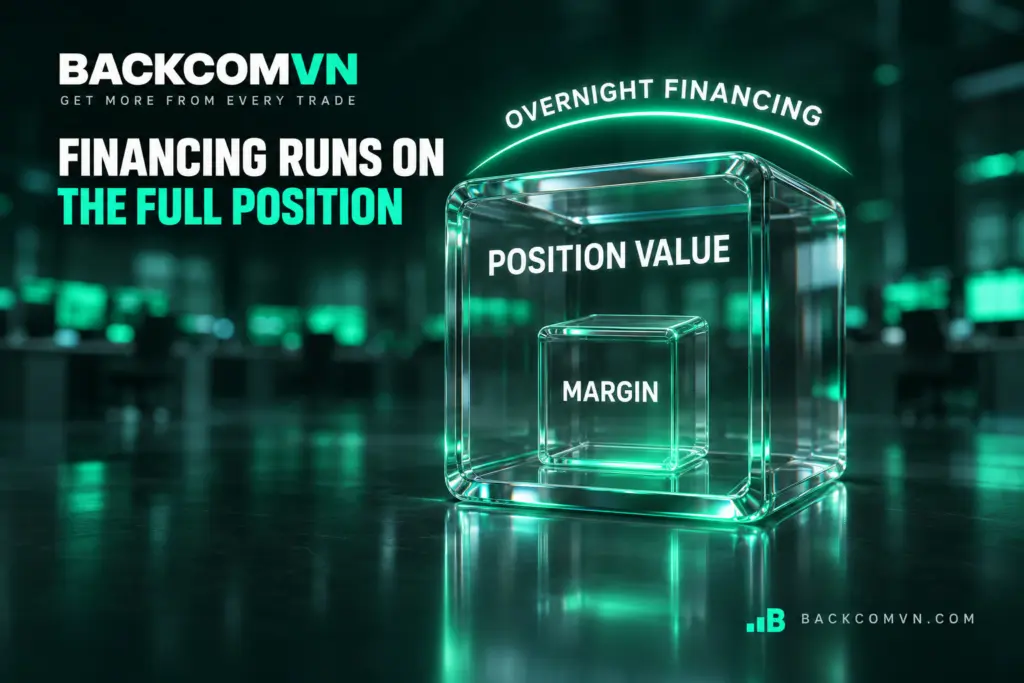
An index CFD uses leverage, so holding a position overnight commonly incurs financing linked to the funds provided to maintain that position. The calculation usually relates to the contract’s notional value. It is therefore important to distinguish the full position value from the margin you have deposited when identifying the charging basis.
A general formula is: one night’s financing = number of contracts × contract value × price × (reference interest rate ± surcharge) ÷ day-count denominator. The denominator is commonly 360 or 365, depending on the currency and provider. Check how every variable is defined, particularly the units used for contract value.
You can compare explanations of the formula in IG’s overnight funding guide and the overnight financing section of Saxo’s CFD pricing. Read each explanation alongside the terms for the specific product, since the definitions and conditions must match the contract you are calculating.
An assumed example: calculating financing step by step
Suppose a long position is 0.5 lots, the contract multiplier represents USD 2 per point per lot and the charging price is 10,000 points. Assume a reference rate of 5% a year, a long-position surcharge of 2.3% a year and a denominator of 365. This price is used only for the calculation; point value per lot varies between brokers.
- Assume the specifications above apply: the notional value is 0.5 × 2 × 10,000 = USD 10,000.
- Assume the surcharge is added for the long position: the financing rate is 5% + 2.3% = 7.3% a year.
- Assume one night represents one financing day: the debit is 10,000 × 0.073 ÷ 365 = USD 2.
Do not automatically apply the long-position result to a short position. A short position may receive a credit or still incur a debit, depending on interest rates, surcharges and the sign convention. When checking index CFD costs, read the terms for each direction separately and confirm how the amount appears on the statement.
Opening and closing within the same trading day, before the cut-off, generally avoids financing. However, the provider determines that cut-off; the date on your local clock is not enough to establish whether a charge applies. Weekend financing may be grouped into a weekday charge, so the number of entries can differ from the number of financing days.
For spot indices, dividend adjustments may be credits or debits depending on position direction. Futures-based contracts may not charge overnight financing through this mechanism, but costs may be reflected in the price and the contract has an expiry date. The guides to overnight fees and swaps and whether swap-free accounts are really free help with reading the full conditions.
Holding intraday or across several days

Holding time changes the composition of index CFD costs. For trades closed before the cut-off, the spread and commission are usually the main components to examine. When an index CFD position remains open for several days, accumulated financing can become substantially larger than the initial spread, changing which charge matters most in the comparison.
Suppose we continue with 0.5 lots, a point value of USD 2 per lot and a monetary spread cost of USD 2; point value per lot varies between brokers. Assume round-trip commission of USD 1, round-trip conversion differences of USD 0.50 and an eligible rebate of USD 0.50. Assume fixed financing of USD 2 per night, with each night representing one charging day and no dividend adjustments.
For this table, assume the price and financing rate remain unchanged and the charging calendar adds no days beyond those shown. If the actual schedule groups weekend financing into another charge, replace the number of nights with the equivalent number of financing days specified for the product before using this comparison.
| Assumed nights held | Spread + commission + conversion (USD) | Financing (USD) | Rebate (USD) | Total cost (USD) |
|---|---|---|---|---|
| 0 | 3.50 | 0 | 0.50 | 3 |
| 1 | 3.50 | 2 | 0.50 | 5 |
| 5 | 3.50 | 10 | 0.50 | 13 |
| 20 | 3.50 | 40 | 0.50 | 43 |
Suppose the position is held for 20 nights under the table’s assumptions: the total is 2 + 1 + 40 + 0.50 − 0.50 = USD 43. Assume those same conditions, and financing is twenty times the spread. This illustrates the effect of holding time; it does not predict the charge on an actual trade.
The table does not include gains or losses from movements in the index itself. When checking a statement, separate the result from price movements from the individual charges so that you can reconcile each component. The guide to six hidden trading costs provides a broader list of items to examine.
Are rebates available on indices?
Not every broker offers rebates on indices. An account that qualifies for forex rebates does not automatically qualify for rebates on index symbols. Check the exact product symbol, account type, unit used to calculate the rebate and conditions for recognising trading volume before including a rebate for an index CFD trade.
To include rebates in index CFD costs, first express the rebate in the same currency and for the same trading size as the other components. Do not subtract a per-lot rebate directly from the cost of a position with a different size. Until eligibility is confirmed, leave the rebate outside the main calculation.
The comparison formula is: spread + commission + financing for the holding period + currency conversion differences − eligible rebate. Track any dividend adjustment separately, then include it when reconciling cash movements. Also distinguish an expected rebate from one that has already been recorded; they represent different stages in checking the actual account entries.
Do not judge the arrangement solely by the advertised rebate. Compare spread, commission and financing conditions for the same product, size, time and position direction. The discussion of whether rebates worsen spreads explains what needs verifying when comparing account configurations, so that the rebate can be assessed alongside the associated charges.
Frequently asked questions
Is overnight financing charged if an index trade closes intraday?
Usually not, provided both opening and closing take place before the relevant cut-off. Check the server time and the rules defining the trading day for the index CFD concerned. Whether you have gone to bed, or whether your local calendar has moved to a new date, does not determine the charge.
Can a short index position receive overnight financing?
It may receive a credit, but it may also incur a debit. The outcome depends on the reference interest rate, surcharge and calculation rules for short positions. Read the specifications for the exact symbol and check the recorded transaction, rather than assuming that selling an index always results in a financing payment to you.
Does a lower spread mean a cheaper trade?
A lower displayed spread is not enough to establish that. Different point values can produce different monetary costs even when the quoted spread is smaller. After putting the comparison on the same market-exposure basis, you still need to add commission, financing and conversion differences before allowing for any rebate that meets the eligibility conditions.
Why does overnight financing differ from my calculation?
Check the price used as the charging basis, the applicable rate, the day-count denominator and the number of financing days grouped into the entry. Then check the charging currency and any dividend adjustment. Even a calculation that follows the formula correctly can differ if it uses specifications or rates from another point in time.
Does depositing more margin reduce financing?
You should not assume so. Under a formula based on notional value, depositing more money does not automatically reduce the charging basis if the position size stays the same. Check the mechanism used for the particular index CFD, and do not substitute the account balance for the value of the position in the calculation.
Conclusion
Calculating index CFD costs starts with the correct contract units, followed by the spread, commission and holding period. A tracking sheet should record the symbol, position size, point value, quote time, financing method and result currency. Keeping those details together makes it possible to revisit the calculation and check that its inputs match the trade.
Subtract a rebate only when the product meets the eligibility conditions. For positions held over several days, give particular attention to financing and the schedule for grouped charges, since this component can greatly exceed the spread. Comparing estimates with statements helps identify whether differences come from units, timing or the conditions applied to the position.
This content is for information only. It is not investment advice or a promise of profit. Leveraged forex and CFD trading carries a high level of risk and may result in the loss of all your capital. Broker figures and conditions change over time; check the relevant broker’s website before making a decision.
The Backcom VN editorial team
The Backcom VN editorial team tracks forex trading costs: the fee schedules, rebate levels and licences of eight brokers, together with the market figures that feed into the cost of each trade. Every number we publish carries a public source and the date it was accessed, so you can check it yourself.
Related articles

Exness or XM: the figures side by side, not a ranking
XM pays more on all six products, in places three times as much. But the starting spread is 1.6 pips…

XM pays the rebate into My Wallet: what changes and what to watch
XM is one of the few large brokers that pays into a separate wallet rather than the trading account. One…

Which Exness account to choose: the five types side by side
The rebate across Exness's five account types varies almost fivefold, from $3 to $14.40 a lot. But the high rebate…

Is a 100% rebate real? Taking the claim apart
The claim can be technically true and still completely misleading, depending on what follows the word "of". Four questions that…

How to get your Exness rebate: setup, payout and checks
The three steps that put an Exness account under a rebate, when the money lands, and what to check first…

Why use a trading rebate — and when it is not worth it
A rebate moves your cost column, not your results column. What it changes, what it does not, and three cases…