
 The Backcom VN editorial team
22 min read

In this article8
Recognising a forex scam starts with information you can cross-check: the legal entity, its licence, where the money goes and who controls the account. This article explains seven warning signs, outlines initial checks and sets out what to prioritise if you have already transferred money. One warning sign alone does not establish fraud, but it is enough to pause and ask for a written explanation before proceeding.
Last updated: 06/11/2026.
Why a forex scam can be difficult to identify in Vietnam
According to a news report published in March 2021, ministry leaders stated that Forex platform operations did not comply with the law. The State Bank of Vietnam has also repeatedly stated that it has not licensed any Forex platform. These statements relate to the time they were made. Readers should check current rules; this article’s update date does not mean the legal position has been reconfirmed on that date.
This context can make it difficult for participants to obtain protection when something goes wrong. An overseas licence does not, by itself, establish which activities are permitted in Vietnam. When you read about whether forex is legal in Vietnam, distinguish between the licensing jurisdiction, the entity serving you and the protection described in your contract. Keep those distinctions in mind when you check a broker licence.
In private groups, newcomers often see trading screenshots, messages of thanks and explanations filled with technical terms. Members may repeat the same message, while questions about withdrawals are moved into private conversations. What is visible in the group therefore may not reflect participants’ experiences in full, particularly where questions and responses are no longer available for everyone to read.
The difficulty is that a professional appearance can come before verifiable evidence. An attractive interface, moving prices or an attentive adviser cannot replace checks on the party receiving your money. Ask who is named in the contract, who holds the funds and who handles withdrawal requests. Those answers matter more than how convincing the presentation appears.
Seven forex scam warning signs that should make you pause
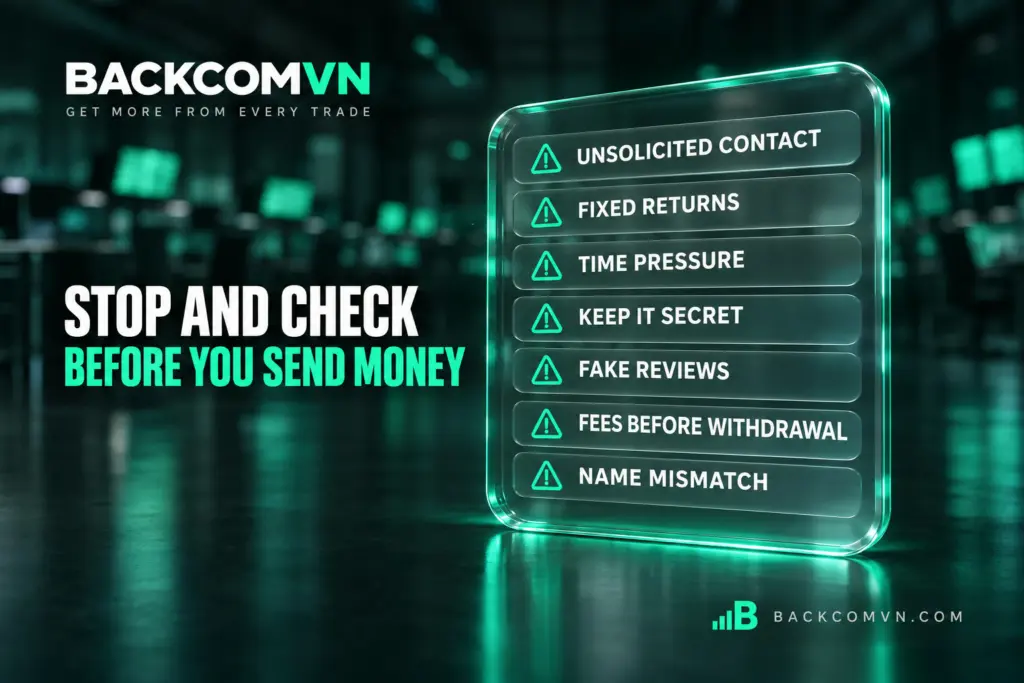
The table below is an initial screening tool. “Five minutes” means time spent looking for inconsistencies, rather than enough time to reach a conclusion about fraud. Where you cannot cross-check a claim, leave it marked as unverified instead of treating the absence of an immediate answer as confirmation.
| Warning sign | Why it raises concerns | What to check in five minutes |
|---|---|---|
| Unexpected contact followed by a group invitation | The person builds a relationship before you have checked their identity. | Ask how they obtained your contact details and what their role is; save the response. |
| Promises of fixed returns with little mention of losses | Results are presented separately from trading risks. | Request a written explanation of who bears losses and where payouts come from. |
| Pressure to transfer money before a short deadline | You have less time to read and cross-check the conditions. | Pause the conversation to make independent checks; record their reaction to your delay. |
| Requests to keep matters secret from your bank or family | Independent checks are being discouraged. | Save the exact request; do not follow instructions to conceal the purpose of a transfer. |
| A licence, legal entity or domain that does not match | Another organisation’s details may be used to create credibility. | Compare the name in the contract with the record on the regulator’s website. |
| Only profit screenshots and customer stories are provided | Images and testimonials may be staged. | Look outside the group; request data you can cross-check rather than screenshots. |
| Additional payments are demanded to enable withdrawals | A withdrawal request becomes a reason to collect more money. | Check the terms you accepted and request the basis for the charge. |
Three easily overlooked forex scam indicators are secrecy requests, testimonials without identifiable sources and mismatched legal entities. They attract less attention than promises of fixed returns, yet each directly affects your ability to verify what you are being told and establish who is responsible.
First, secrecy may be presented as a way to prevent the bank from “misunderstanding”. Distinguish between protecting personal information and being asked to misstate the purpose of a transfer. You do not need to make your account details public, but you still need to be able to communicate honestly with your bank.
Second, numerous positive comments do not necessarily represent numerous independent sources. The same withdrawal screenshot may circulate across several groups. Look for context, withdrawal conditions and any referral relationship disclosed by the person sharing it. The number of reactions or comments does not verify the account they give.
Third, a licence may exist but belong to a different legal entity from the one signing your contract. Similar branding does not resolve that discrepancy. Read the section identifying the service provider, rather than relying on the logo at the top of the page to establish who you are dealing with.
Four common patterns
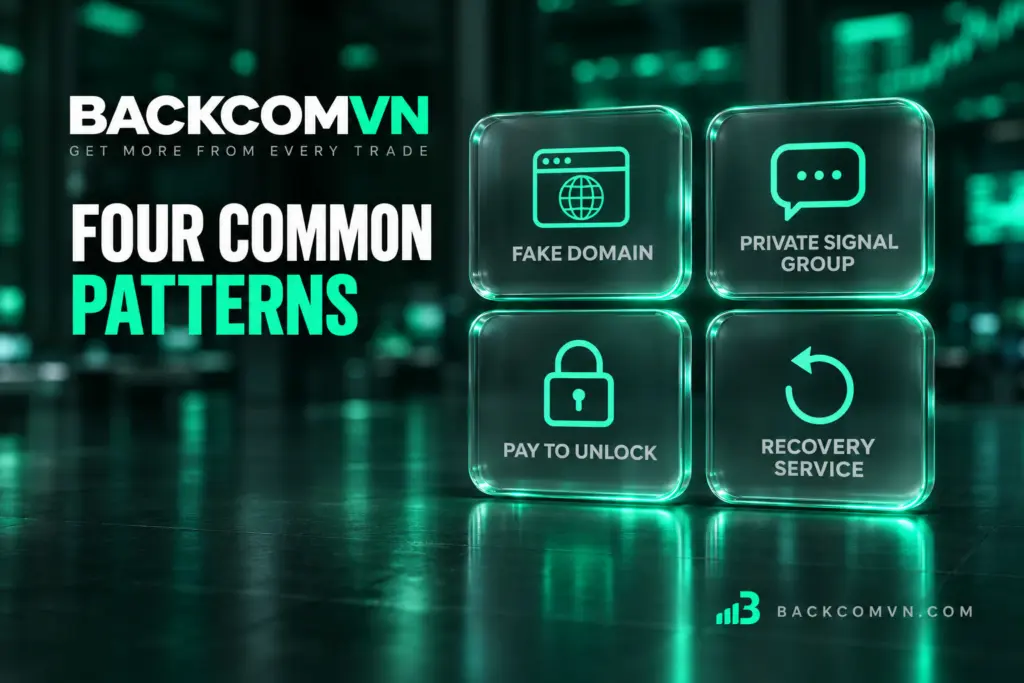
Different forex scam patterns can follow one another: an invitation from a private group leads to a website, followed by demands for more money when you request a withdrawal. Identify the point where you surrender control or are asked to rely on information you cannot independently cross-check.
Fake platforms and imitation domains
A website can copy another organisation’s branding, interface and licence details. An alert about websites impersonating Moneysmart from ASIC shows that even a regulator’s identity can be misused to promote investments requiring a small initial deposit. A familiar logo is not evidence that the website or the offer is authentic.
The point to pause is before logging in: independently compare the website address with the official record. If someone supplies an alternative link because “the site is blocked”, review the risk of imitation domains when a platform is blocked before entering your details.
Private signal groups that offer account management
A group may begin by sharing market commentary, then invite members to use copy trading or let someone else operate their accounts. Screenshots of favourable trades encourage newcomers to deposit more or hand over control. Copy trading itself, however, is not enough to establish that anyone has acted fraudulently.
Before handing over access, establish who can place trades, who can withdraw money and how to stop copying. If the person making the offer avoids questions about losses, requests a separate transfer or demands your password, pause the handover until those issues have been addressed.
Fees demanded before withdrawals are released
When a user requests a withdrawal, the operator introduces an “unlocking fee”, “tax” or verification payment that must be paid separately. Another condition may appear after each transfer. A balance displayed on a screen does not demonstrate that the money can actually be transferred back to your account.
Pause before sending more money simply to see whether the withdrawal will work this time. Review the possible reasons for being unable to withdraw, request the basis for the charge and retain the complete history of how your request has been handled.
Recovery services that approach you afterwards
After losing money, users may be approached by someone claiming to help recover it. They know part of the story, promise to retrieve the funds and then request an upfront fee. This is often a second round of collecting money. Independently verify their identity and proposed scope of work before proceeding. Knowledge of your previous transactions is not, on its own, evidence that they are trustworthy.
A ten-minute initial forex scam check
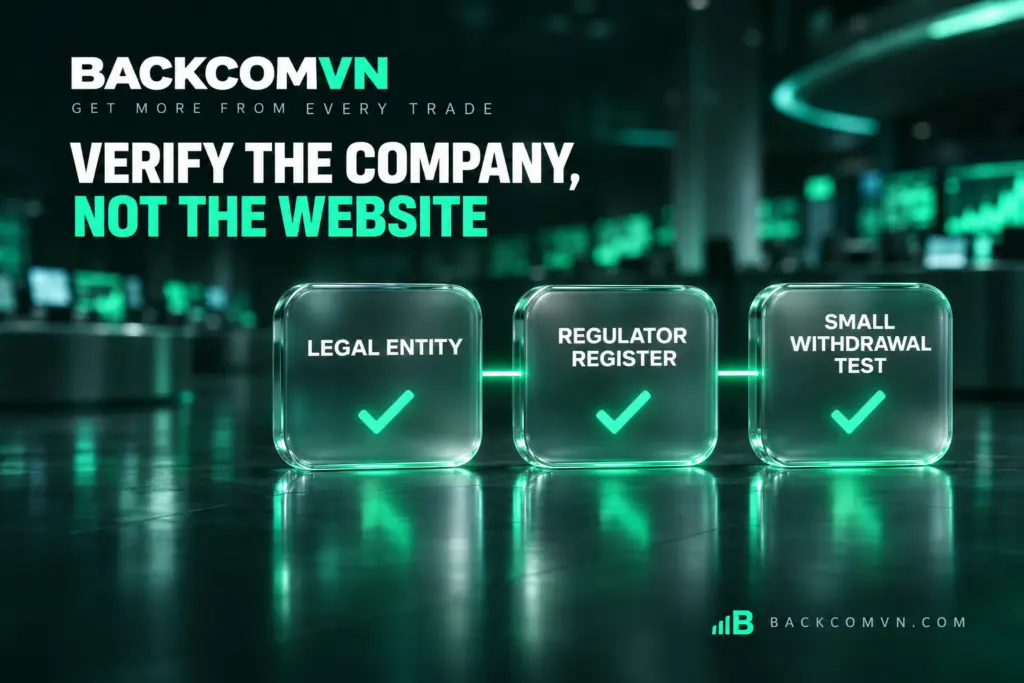
Ten minutes is enough only for an initial review of the information, not to confirm that a broker is safe. A withdrawal request may take longer to process. Do not deposit new money merely to complete this check or turn an information review into a financial test.
- Identify the correct legal entity. Open the contract or account terms and record the service provider’s full name. Compare it with the name in the payment details. If they differ, request a written explanation of the relationship.
- Check a broker licence at its source. Type the regulator’s website address yourself and search for the name or registration number. Read the status, permitted activities and contact details; a search result with a matching name is not enough.
- Search warning lists. Look up the brand, legal entity and domain. The recommendation to check the Warning List from the FCA applies before investing. Absence from a warning list does not establish safety.
- Try a small withdrawal if you already have funds deposited. Record the request time, amount, fees and response. One successful withdrawal confirms only that particular transaction; it does not confirm that every future withdrawal will succeed.
- Read the withdrawal conditions carefully. Check identity verification, the receiving method, processing times and any conditions attached to bonuses. Keep a copy of the terms so you can compare them with requirements introduced later.
What should match when you check a broker licence?
Match at least the legal entity’s name, licence status and website details where the official record provides them. This guide to check a broker licence in five steps helps organise the comparison. When assessing a possible forex scam, an inconsistency needs an explanation. Do not disregard it simply because a staff member describes it as standard practice.
A rebate service also needs checking
A rebate arrangement is a payment relationship that needs a verifiable basis. You need to know how the rebate is calculated, which trading volume qualifies, when payment is due and where you will receive it. An advertised figure alone cannot answer those questions or explain the conditions attached to payment.
| What should be provided | What to avoid |
|---|---|
| A clear calculation basis and eligibility conditions | Unusually high rebates relative to the commission the broker can pay |
| Registration instructions that can be verified | Demands for a separate payment to receive rebates |
| Users retain control of account access | Requests for login or trading passwords |
| Volume data that can be reconciled for each period | Only a total payment figure, without the calculation basis |
| A clearly communicated payment cycle and destination | Repeated schedule changes or delays across several periods without explanation |
Backcom VN is an Introducing Broker. The broker pays commission based on trading volume, most of which is returned to users. This creates a conflict of interest because income is linked to volume. Readers should apply this checklist to Backcom VN as well and read its editorial standards and conflict of interest disclosures.
Demanding your login password is unacceptable. A read-only password should also not be shared with strangers because it still exposes account information. If your rebate has not arrived, first reconcile the payment period and recorded volume. A delayed payment needs an explanation, but delay alone is not enough to establish a forex scam.
Scammed in forex: what to do first
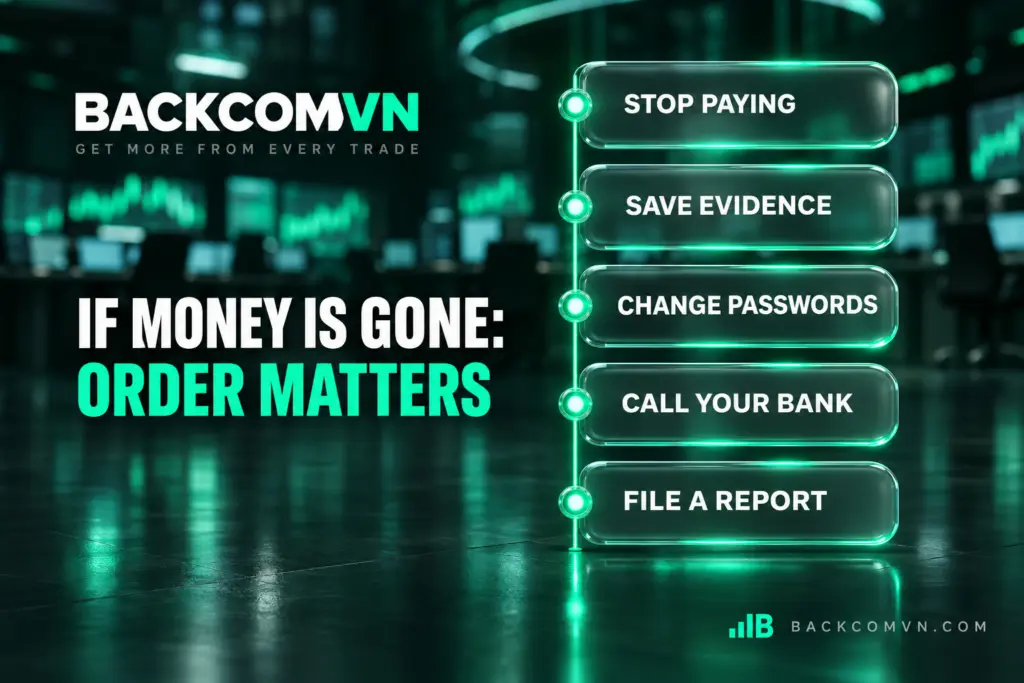
If you suspect a forex scam, prioritise limiting further losses and preserving evidence. There is no guarantee that money can be recovered. Contacting your bank or making a report also does not mean that your case will necessarily be accepted for investigation or that you will receive a refund.
- Stop transferring more money. Do not pay a supposed verification fee, unlocking charge or tax simply because your contact says it is the final step. Pause any action based on new payment instructions.
- Save the evidence. Keep messages, website addresses, contracts, deposit and withdrawal histories, transaction references and recipient details. Arrange them chronologically, retaining the original records alongside your summary of events.
- Change your passwords. Prioritise email and accounts for which you have shared access. Change passwords elsewhere if you reused them. Review active login sessions and any copy trading permissions that remain enabled.
- Contact your bank. Use its official contact channels, provide transaction details and ask what assistance may be available. What can be done depends on the transaction’s status and the relevant procedures.
- Report the matter to the police where you live. Bring your account of events, evidence and collected contact details, and ask for procedural guidance. Clearly distinguish what you witnessed directly from what you suspect or infer.
- Be cautious about recovery services. Do not pay upfront solely on the strength of a promise. Do not give further passwords, authentication codes or device control to someone who approaches you unsolicited.
If someone is accessing your account without authorisation, prioritise blocking that access and contacting your bank immediately. Do not wait until you have assembled every document. These steps help preserve and organise information for follow-up; they are not legal advice.
Frequently asked questions
Can there still be a forex scam risk with an overseas licence?
Verification is still necessary. A licence number may be copied, a website may be an imitation or the contract may name a different legal entity. When you check a broker licence and the details match, you still need to read the permitted scope of activities and the dispute resolution arrangements applicable to your account.
Does a successful first withdrawal establish trust?
It is not enough. That withdrawal shows only that one request was processed. It does not confirm that another amount can be withdrawn at another time, nor does it replace checks on the legal entity. Do not use one successful payment as a reason to stop reading the terms.
What if a broker demands tax before allowing a withdrawal?
Pause the new transfer and request the basis for the payment, its calculation, the collecting entity and supporting documents. A staff member’s message does not establish a tax obligation. If you need to determine a specific obligation, consult official sources or seek appropriate professional assistance.
Should you share a read-only password to receive rebates?
Do not share it with strangers. Read-only access can still reveal your balance, trading history and trading approach. Ask for a reconciliation method that does not require a password. Provide only the data needed for that check and conceal information that is unrelated to it.
Does losing money through copy trading mean you were deceived?
A loss alone does not establish fraud. Review the permissions you granted, what was represented to you and the actual trades. The questions to clarify are whether information was misleading, actions exceeded the authority given or money was used differently from what had been agreed.
Conclusion
A forex scam check begins by separating promotional claims from verifiable information. Identify the legal entity, independently check a broker licence, read withdrawal conditions and retain control of your account. When answers do not match, pausing is a reasonable way to make room for clarification before making another decision.
Apply the same standards to brokers, people offering account management and rebate providers, including Backcom VN. If you have already transferred money and notice inconsistencies, prioritise stopping further transfers, securing your accounts, saving evidence and contacting the appropriate organisations. Avoid making your next decision solely because you want to recover money already lost.
This content is for information only. It is not investment advice, legal advice or a promise of profit. Leveraged forex and CFD trading carries a high level of risk and can result in the loss of all your capital. Regulations and individual brokers’ conditions change over time; check official sources before making a decision.
The Backcom VN editorial team
The Backcom VN editorial team tracks forex trading costs: the fee schedules, rebate levels and licences of eight brokers, together with the market figures that feed into the cost of each trade. Every number we publish carries a public source and the date it was accessed, so you can check it yourself.
Related articles

IC Markets review 2026: is IC Markets trustworthy?
IC Markets runs three entities and only one signs your contract. What the ASIC licence does and does not cover,…

XM review 2026: is XM trustworthy?
XM holds four licences, and the one on the homepage is probably not yours. Which entity signs your contract, what…

Editorial standards: where our figures come from and how we correct errors
Sources, verification, what happens when we get something wrong, and Backcom VN's conflict of interest stated plainly - including a…

Which forex broker is trustworthy? The question to ask instead
Licences across eight brokers, plus what the table does not say: international clients are nearly always on an offshore entity,…

VT Markets review 2026: is VT Markets trustworthy?
VT Markets holds three licences, but the ASIC one covers wholesale clients only. Which entity signs your contract, how to…

Vantage review 2026: is Vantage regulated?
Vantage holds five licences across five jurisdictions, but only one entity actually serves you. Which one it is decides how…