
 The Backcom VN editorial team
20 min read

In this article6
When considering why use a forex rebate, an attractive rate is only the starting point. The practical questions are whether the amount returned matters at your current trading volume, whether account conditions change, and how easily you can check payments. A rebate deserves consideration when it returns part of the costs you already incur. It should never become a reason to choose an unsuitable account or place additional trades.
Last updated: 09/10/2026.
Why use a forex rebate? It reduces costs without changing trade outcomes
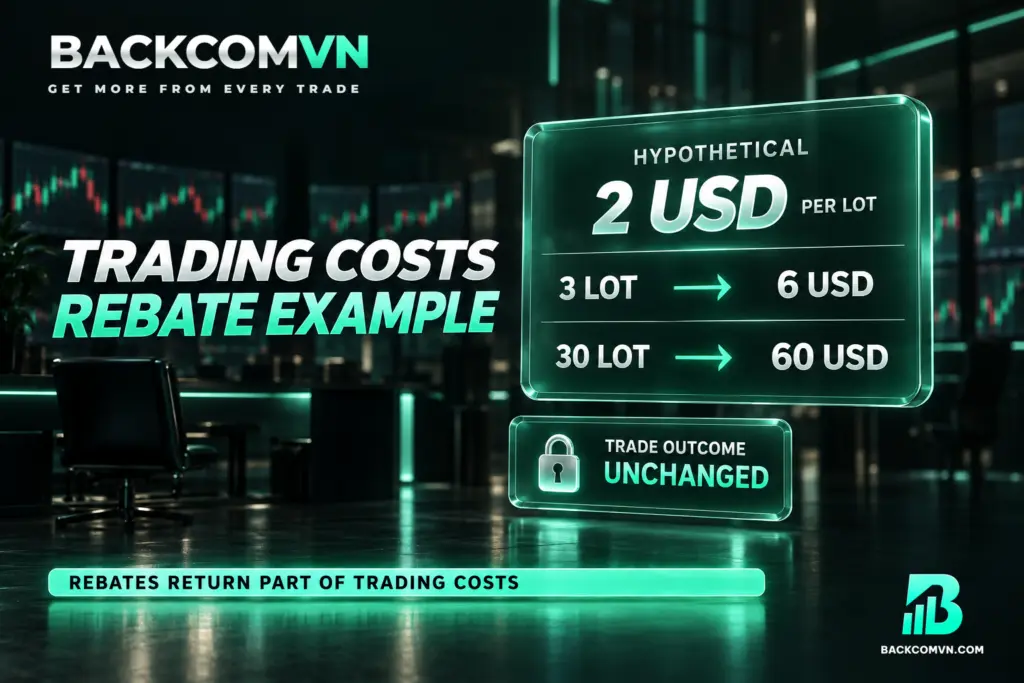
The main reason to consider a rebate is straightforward: you receive back part of the trading costs already incurred. For accounting purposes, this belongs under trading cost reduction and should be recorded separately from whether a trade wins or loses. Receiving a rebate does not improve your entry price or change the market’s movement after you open a position.
If the mechanism is unfamiliar, read the explanation of what forex rebates are and how they work. The essential distinction is that the payment relates to trading activity, rather than rewarding a correct market forecast. Under Backcom VN’s rebate mechanism, payments apply to both winning and losing trades. That makes the rebate a cost item to track independently.
For frequent traders, individual transaction costs need to be assessed across total volume. An amount that looks small on a single trade may become worth monitoring over a full payment period. However, trade count tells only part of the story. When a rebate is calculated per lot, you need the total number of lots traded, rather than simply the number of transactions.
| What a rebate changes | What a rebate does NOT change |
|---|---|
| Returns part of the trading costs already incurred. | Does not change whether a trade wins or loses. |
| Adds a payment to record when reconciling costs. | Does not change your entry point or subsequent price movements. |
| Has a separate payment schedule and destination, depending on the broker. | Does not make account conditions identical across brokers. |
| Provides rebate figures on a dashboard to check against trade history. | Does not replace checking licensing and execution conditions. |
Hypothetical example: suppose an arrangement returns 2 USD per lot. This is purely illustrative and does not represent any broker’s offer. If your already planned volume for the period is 3 lots, the assumed rebate would be 6 USD; at 30 lots, it would be 60 USD. The calculation demonstrates only the size of the payment at those volumes.
Neither amount tells you anything about the quality of the trading. Use your planned volume to estimate the rebate, rather than setting a rebate target and increasing volume to reach it. In your records, place this payment alongside the charges discussed in how to calculate the total cost of a forex trade, so you can assess costs together.
Redirecting an existing referral commission
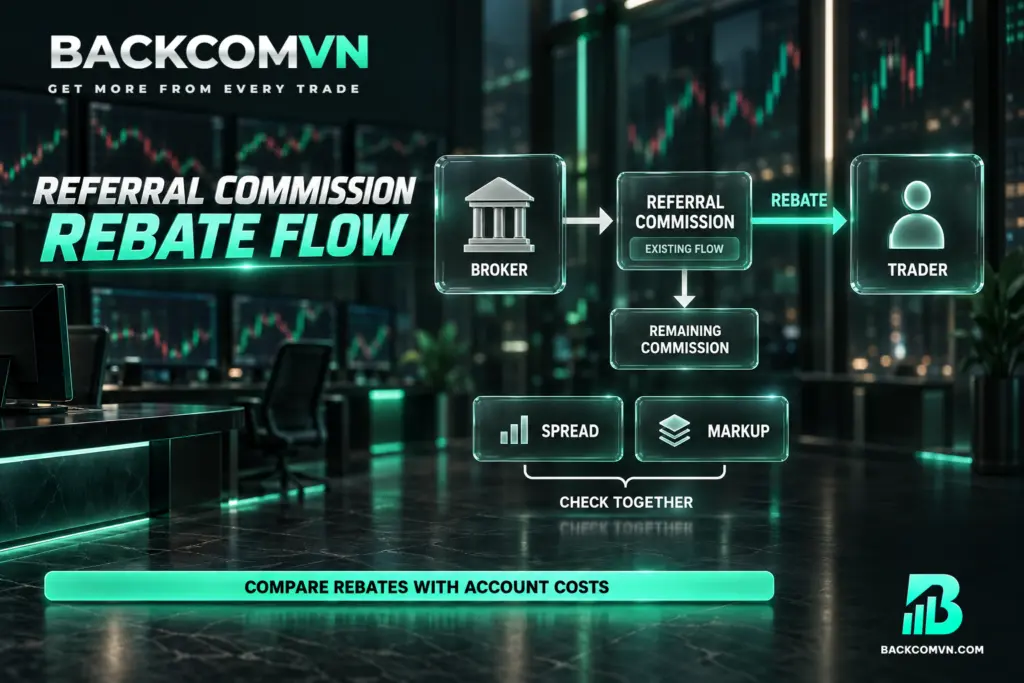
Within this arrangement, introducing broker commission already arises whether or not the trader registers through a rebate service. Setting up a rebate redirects part of that existing payment to the trader. The amount returned therefore belongs within the distribution of trading costs. It should not be treated as a separate trading result or evidence that a trading decision was successful.
This mechanism does not establish that every registration route carries identical costs. Some Backcom VN options pair different rebate rates with different markups. Before opening an account, read the amount returned together with the associated spread conditions. A comparison that includes only the rebate leaves out part of the information needed to assess the overall cost.
For example, Vantage offers Standard and High Backcom options with different spreads, while HFM offers No Markup and Markup 1. EC Markets and Ultima Markets each have three options: No Markup, Markup 1 and Markup 2. These choices illustrate why a higher rebate must be evaluated alongside its corresponding charges. The headline payment alone cannot establish which option costs less.
To check specific rates, compare rebate rates by trading product with the conditions of the account you intend to use. For the options on the Vantage rebate page, choose the appropriate registration link before opening the account. Each link has an associated markup, and that choice cannot be changed after the account has been opened.
Practical value depends on setup and verification
Backcom VN lists eight brokers and offers ongoing rebates after a single registration, with no minimum trading volume requirement. This means participation does not require you to trade enough to meet a volume threshold. However, the absence of a minimum does not mean the payment will necessarily be substantial. Its practical value still depends on your existing activity and account conditions.
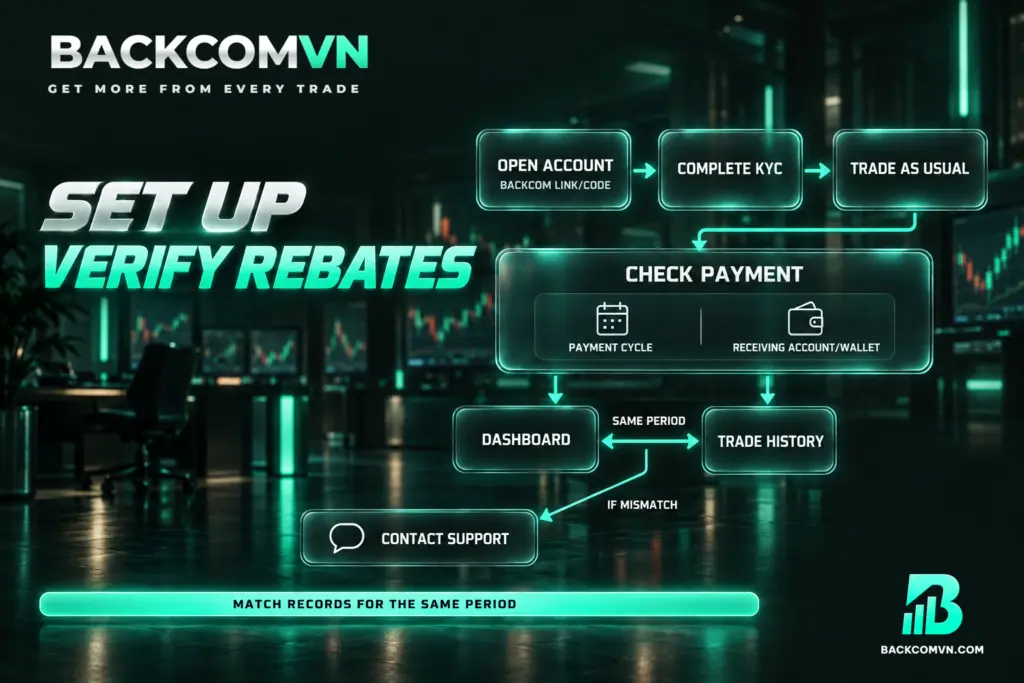
The general process is to open an account using Backcom’s referral link or code, complete the broker’s identity verification, known as KYC, and trade as usual. Listed KYC documents include a citizen identity card, driving licence or passport. Accounts opened under Backcom are recorded automatically, so a separate account-linking step is not required as part of that general registration process.
Account recognition and broker-specific rebate payment setup are separate matters. VT Markets requires users to contact support to arrange automatic Backcom payments. If you already have an account, support can guide you through changing your introducing broker, or IB. Read the IB transfer process and points to check before starting, so you understand the steps applicable to your account.
Payment timing and destination also affect verification. Most listed brokers pay daily, while IC Markets pays every Monday. Depending on the broker, payments may reach a trading account, My Wallet or the Backcom VN Wallet. The comparison of when rebates arrive and where they are paid helps you identify the appropriate place and time to check.
- Before trading: confirm the broker, account type and markup option under which you registered.
- When payment is due: check the receiving account or wallet used by that broker.
- When reconciling payments: compare dashboard figures with trade history covering the same period.
- If figures differ: contact Vietnamese-language support through Telegram or Zalo to investigate.
The ability to reconcile payments is a practical reason to use the service: it gives traders a basis for checking what they have received. Even so, dashboard figures need to be read alongside trade history and the payment schedule. A balance viewed at a single moment is insufficient to assess the rebate for an entire period, particularly if the relevant payment is not yet due.
Is a forex rebate worth it? When it should take lower priority
Your trading volume is very small. If you trade infrequently, the expected payment may be modest compared with the time needed to research, set up and monitor the arrangement. There is no universal threshold that suits everyone. Estimate the rebate using your current volume, then decide whether it warrants attention. Increasing activity to make registration seem worthwhile defeats the purpose of trading cost reduction.
You choose a broker solely for its high rebate. Licensing and execution conditions require their own assessment. A rebate table cannot answer those questions, however clearly it presents the rates. If you have not checked these underlying factors, ranking brokers by the amount returned per lot leaves the decision without an adequate basis. Complete those checks before letting the rebate influence your choice.
You overlook the associated spread or markup. Comparing two rebate options is meaningful only when their corresponding costs are included. A larger payment does not, by itself, demonstrate a lower total cost. This matters particularly where the registration link determines a markup that cannot be changed after account opening. Check the conditions of the specific option before committing to that account.
The rebate becomes a reason to trade more. At this point, the payment is beginning to shape the trading plan. If you would not otherwise have placed a trade, opening it to increase your rebate moves away from reducing the costs of activity already planned. The prospect of receiving money back provides no basis for opening a position or changing your intended volume.
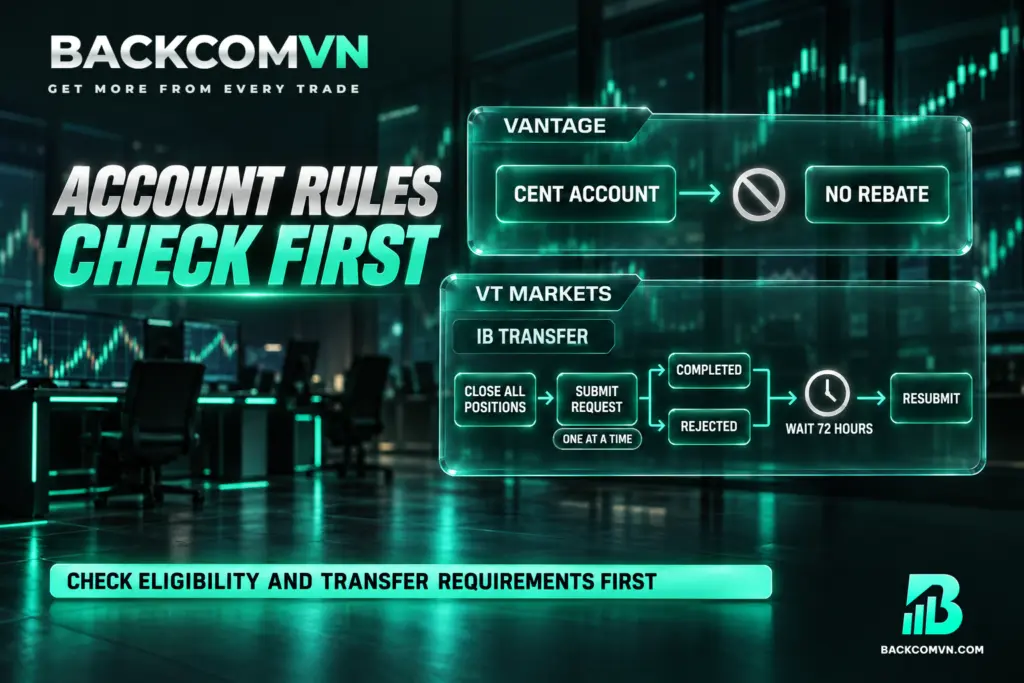
A transfer does not suit your account’s current position. Vantage does not pay rebates on Cent accounts. VT Markets requires all open positions to be closed before submitting a transfer request. You may submit only one request at a time and must wait 72 hours after completion or rejection before applying again. Assess these restrictions against your circumstances before beginning the process.
Frequently asked questions
Can you receive a rebate on losing trades?
Yes. Under the stated mechanism, rebates apply whether a trade wins or loses. Record the payment within your cost accounting and keep the trade’s result separate. Receiving some money back does not change how you should assess the trading decision itself, nor does it demonstrate that the decision was sound.
Is there a minimum trading volume?
Backcom VN states that no minimum trading volume is required. You still need to use an eligible account and complete the steps required for your particular broker. This allows you to keep your existing volume plans, but it does not indicate whether the resulting rebate will be large or small.
Does every broker pay daily?
No. Among the eight brokers, IC Markets pays every Monday through the Backcom VN Wallet; the others follow daily payment cycles. If you use this broker, check the conditions on the IC Markets rebate page. Applying another broker’s schedule could lead you to check for a payment before it is due.
How do you set up rebates for an existing account?
The process depends on the broker. Some provide instructions for requesting an IB transfer from your registered email address; HFM has a Set Partner & Campaign ID section in its app. Identify the correct procedure and ask support to check the status. Submitting a request should not be taken as confirmation that the transfer is complete.
Is a higher rebate the better choice?
The rate alone is insufficient to decide. Check the spread, markup, account type and relevant trading product, then assess the payment against your planned volume. This gives the rebate the necessary cost context. Broker licensing and execution conditions remain separate checks and cannot be inferred from how much an arrangement returns.
Conclusion
A rebate has value when it returns part of the cost of trades you already intended to make, under suitable account conditions and with figures you can verify. Start your assessment with actual volume, associated charges, payment timing and the destination of the money. Together, these determine its usefulness for trading cost reduction.
If the expected amount is too small, transferring creates inconvenience, or the rate distracts you from broker quality, immediate setup may not be worthwhile. Keep trading decisions independent of the payment you expect to receive. Rebates should support cost management, while your trading plan continues to determine whether to trade and how much volume is appropriate.
This article is for information only. It is not investment advice and not a promise of returns. Leveraged forex and CFD trading carries a high level of risk and can result in the loss of your entire capital. Each broker’s figures and conditions change over time — check them against the broker’s own page before you act.
The Backcom VN editorial team
The Backcom VN editorial team tracks forex trading costs: the fee schedules, rebate levels and licences of eight brokers, together with the market figures that feed into the cost of each trade. Every number we publish carries a public source and the date it was accessed, so you can check it yourself.
Related articles

How to get your Exness rebate: setup, payout and checks
The three steps that put an Exness account under a rebate, when the money lands, and what to check first…

How to set up a trading rebate: a step-by-step guide to eight brokers
The three steps that put an account under a rebate, a referral-code and payout table for all eight brokers, and…

Account base currency and the VND conversion nobody prices
Your account is in dollars and you fund in dong. The margin on those two conversions appears in no fee…

Vantage deposits and withdrawals: the same-name rule and the 50 USD minimum
Vantage states the rule other brokers let you discover the hard way: funds must be in the same account holder's…

XM deposits and withdrawals: My Wallet, the 2–5 day window and real costs
At XM your money sits in two places, not one — and that is behind almost every 'where are my…

Exness deposits and withdrawals: channels, timing and the real cost
Automatic 24/7 withdrawal solves only one of three legs. The other two are where your money actually leaks.