
 The Backcom VN editorial team
21 min read

In this article8
You fund in Vietnamese dong. Your trading account is denominated in US dollars. Between those two points sits one currency conversion, and when you withdraw there is another. The margin taken on those two conversions appears in no broker fee table, shows up in no trade history, and nobody calls it a fee — yet for anyone funding and withdrawing regularly it can exceed a whole month of spread. This article shows where it sits and how to shrink it.
Last updated: 2 October 2026.
What your account is denominated in
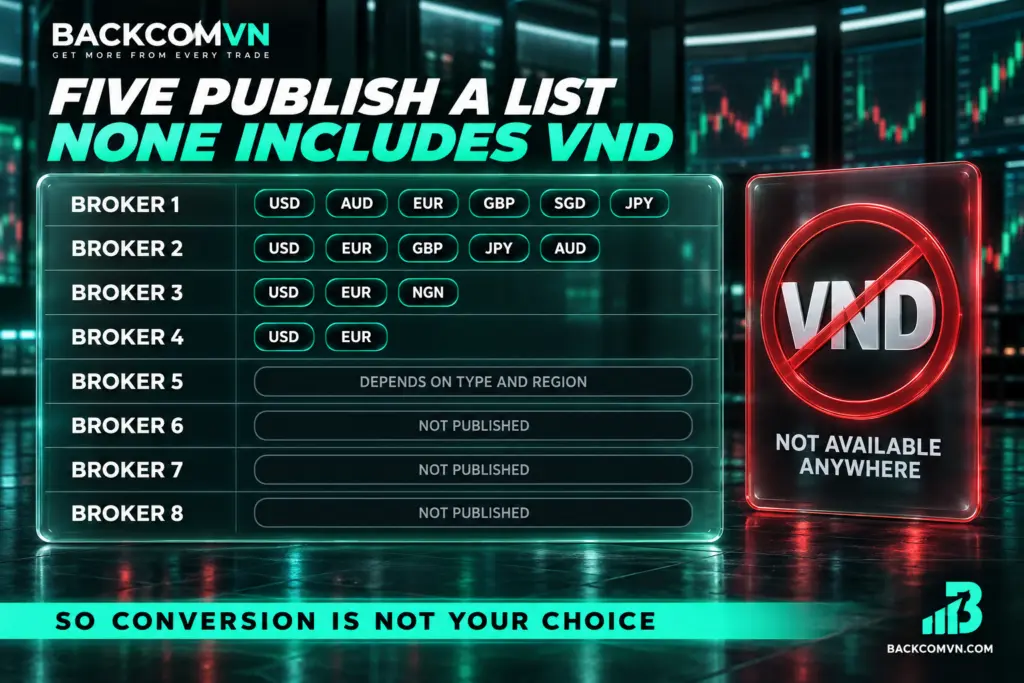
Every trading account has a base currency, chosen when you open it and usually fixed afterwards. Everything inside the account — balance, profit and loss, margin, swap — is denominated in it. Here is what the eight brokers publish:
| Broker | Account currencies published | VND |
|---|---|---|
| IC Markets | USD, AUD, EUR, GBP, SGD, JPY | No |
| XM | USD, EUR, GBP, JPY, AUD | No |
| HFM | USD, EUR, NGN | No |
| Exness | USD, EUR | No |
| Vantage | Depends on account type and region | Not stated |
| EC Markets | Not published | Not published |
| VT Markets | Not published | Not published |
| Ultima Markets | Not published | Not published |
The common thread is worth stating plainly: no broker here publishes a VND-denominated account. Most offer only USD and EUR; IC Markets has the widest choice at six currencies, and HFM carries NGN because of its Nigerian market — but nowhere is there a dong account. IC Markets even lists it among its limitations that direct VND deposits and withdrawals are not supported; see the IC Markets rebate article.
The consequence: your money must be converted at least twice per funding round trip. That is not your choice, so the only thing available to you is knowing what it costs.
Where the margin sits, and why it is not a deposit fee
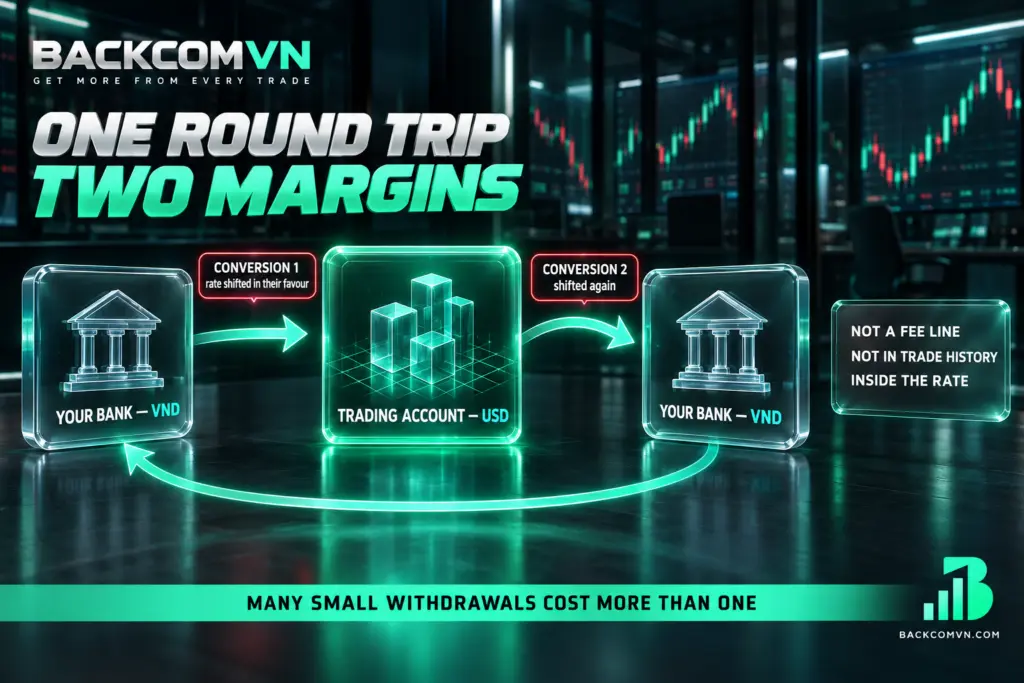
A deposit or withdrawal fee is a number the broker or payment provider publishes: 0%, 0.5%, or a flat amount. What we are discussing here is different — it is the exchange rate margin, and it hides inside the rate itself.
First conversion: VND to USD on the way in
You send dong. By the time it reaches the trading account it is dollars, at a rate set by whoever handled the conversion. That rate is essentially never the mid-market rate you see on Google — it is shifted in favour of the party doing the converting. That shift is the cost, and because it lives inside the rate it never appears on a line labelled “fee”.
Second conversion: USD back to VND on the way out
On withdrawal the direction reverses, and the margin is taken again — again in favour of the converting party. So one complete round trip pays the margin twice, even if you never place a single trade.
This is why withdrawing many small amounts costs more than withdrawing once. And it is why funding and then immediately withdrawing — because you changed your mind, or because you hit a problem withdrawing and funded again — never returns the full original amount.
A third conversion most people miss
If your account is in USD but you trade an instrument not quoted in USD — a cross such as EUR/GBP, for instance — the position’s profit or loss is converted into USD when you close it. This is far smaller than the two conversions above, but it explains why your P&L sometimes differs slightly from your own calculation. Majors, crosses and exotics covers that instrument group.
A calculation to show the scale
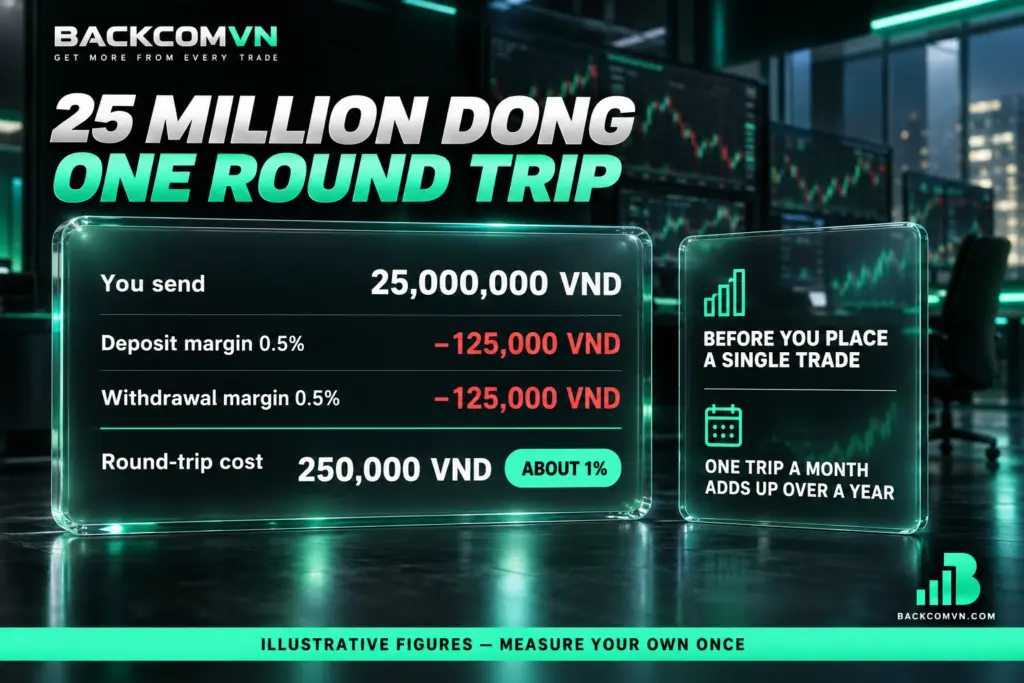
The figures below are an illustration using assumed numbers, not the rates of any particular broker or bank — rates and margins vary by channel and by moment. The point is only to show the order of magnitude.
Suppose you fund 25 million dong, and each conversion carries a 0.5% margin against the mid-market rate:
| Step | Margin | In money |
|---|---|---|
| Deposit: VND to USD | 0.5% | about 125,000 dong |
| Withdrawal: USD to VND | 0.5% | about 125,000 dong |
| One round trip | about 1% | about 250,000 dong |
250,000 dong for one round trip, before trading anything. Set that against the cost of a trade to see the ratio: on EUR/USD at small size, that is equivalent to the cost of a good many trades. If you make one round trip a month, over a year the accumulated conversion margin becomes a figure worth placing next to your spread bill rather than a detail to ignore.
It belongs squarely in the category described in six hidden costs in forex trading: nobody conceals it, it simply has no name.
If the broker lets you choose, USD or EUR?
For a trader funding from Vietnam the answer is almost always USD, for three reasons:
- VND-to-USD channels are more common than VND-to-EUR, so margins are usually thinner. Choosing EUR often means converting twice.
- Most instruments are quoted in USD — gold, oil, the major pairs. A USD account removes the P&L conversion described above.
- Rebates are paid in USD. Every broker’s published rate is in dollars per lot, so a USD account matches directly without an extra conversion.
Choosing EUR only makes sense if your income or funding source is already in euros. Choosing a currency because it “sounds stronger” achieves nothing — the base currency does not affect a trade’s result, only how many times your money is converted.
One caveat: base currency usually cannot be changed after opening. To change it you open a new account and transfer internally — and remember to check the new account is attributed to the right referral path so it still earns a rebate.
Four ways to shrink it
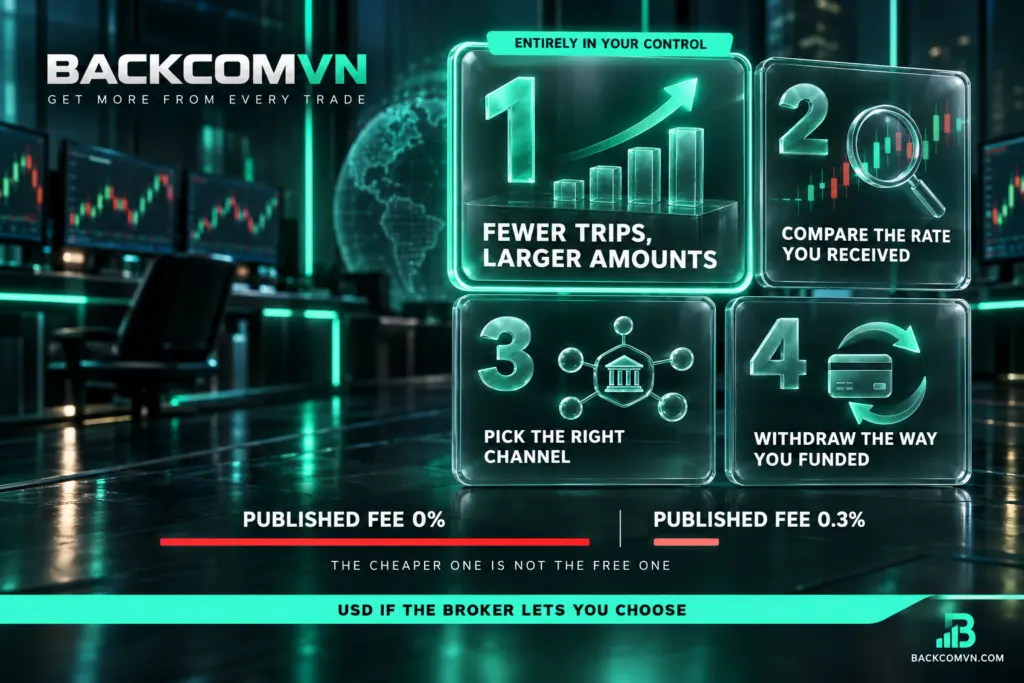
- Fund and withdraw less often, in larger amounts. The margin is charged as a percentage, but the number of times is yours to decide. Two round trips in a month cost twice one. This is the most effective method and costs nothing to apply.
- Compare the rate you actually received, not the published fee. A channel advertising “free deposits” but applying a rate 1% off market is more expensive than one charging 0.3% at close to market. The way to compare: divide the USD that landed in the account by the VND you sent, then check that against the mid-market rate at the time.
- Pick the right funding channel. Each channel carries a different margin and timing; funding a forex account from a Vietnamese bank compares them, and deposit and withdrawal costs and how to cut them covers the published fees.
- Withdraw through the channel you funded with. Many brokers require it anyway, and it usually gives a better rate than routing out through something else. That rule, along with the matching-account-name requirement, appears in the per-broker funding articles — for example Vantage, Exness and XM.
The first method matters more than the other three combined, and it is the only one entirely within your control. Ways to cut costs on the trading side are in seven ways to cut your forex trading costs.
Where rebates fit into this
A rebate is paid in USD and calculated per lot, so it carries no conversion margin on the way in. It does carry one on the way out — when you move it into dong.
Which leads to a practical point: where the rebate lands determines how many conversions you pay. Some brokers pay into an intermediate wallet, others straight into the trading account — the comparison is in when rebates arrive and where. If it lands in the trading account and you trade with it, you never convert that money at all. If you withdraw it every week, you pay the margin weekly on a small sum, which is a materially worse cost ratio than letting it accumulate and withdrawing quarterly.
Frequently asked questions
Does any broker offer a VND account?
None of the eight we reconcile. The five that publish a currency list offer only major foreign currencies; the other three publish nothing on this. If you see somewhere advertising a VND account, check whether it is a real trading account or just a display conversion shown for convenience.
I already opened a EUR account — can I switch it to USD?
Usually not directly. The common route is to open a new USD account in the same client area and transfer funds internally. Ask what rate that internal transfer uses, and check the new account is attributed to the right referral path.
How do I find out what rate I was given?
Divide the USD that arrived in the account by the VND you sent; that is your effective rate. Compare it against the mid-market rate at that moment, and the gap as a percentage is the margin. Do this once for each channel you use, write it down, and you will know which is cheaper without trusting any advertising.
Does base currency affect a trade’s profit or loss?
It does not affect the outcome, but it affects the number you read. The same winning trade shows different figures on a EUR account and a USD account because each is converted differently. Pip value is also denominated in the base currency — see lots, pips and pip value.
Should this be counted in my starting capital?
Yes. If you plan to fund a small amount as a trial, the two conversion margins take a meaningful share of it — one of several reasons the minimum deposit is not the number that decides how much capital you need. How much capital you need to start works from costs rather than from the minimum.
Conclusion
No broker among the eight offers a VND-denominated account, so every funding round trip you make pays for two currency conversions. The margin on those two hides inside the exchange rate, sits in no fee table, and for regular funders ranks alongside the spread.
Three things to do: pick USD if the broker lets you choose, measure your effective rate once per channel, and reduce how often you fund and withdraw rather than hunting for a “free” channel. The last one is the cheapest, because it depends on nobody but you.
This content is informational. It is not investment advice and not a promise of returns. Leveraged forex and CFD trading carries a high level of risk and can result in the loss of all invested capital. Exchange rates, margins and funding channel lists change by moment and by channel, and the figures in this article are illustrative assumptions — verify them in your own client area before acting.
The Backcom VN editorial team
The Backcom VN editorial team tracks forex trading costs: the fee schedules, rebate levels and licences of eight brokers, together with the market figures that feed into the cost of each trade. Every number we publish carries a public source and the date it was accessed, so you can check it yourself.
Related articles

Seven common misconceptions about trading rebates
A rebate is a simple mechanism surrounded by confusion, most of it created by how the industry advertises it. The…

When rebates arrive and where: eight brokers compared
Most forex brokers pay daily, but the destination differs: the trading account, the broker's own wallet, or an intermediary wallet.…

Forex broker rebates compared, instrument by instrument
Four brokers' rebate rates side by side on the same instruments in the same unit, USD per lot. Gold ranges…

What the spread is, and how to read it on the platform
Platforms show the spread in points, not pips: a spread of 12 on EUR/USD is 1.2 pips, roughly $12 per…

XM or HFM: the two with the lowest entry thresholds
XM pays more on every product but HFM starts from a tighter spread. And HFM publishes rebate figures for only…

Exness or Vantage: licences, entry thresholds and net cost
Vantage opens an ECN account at $50 where Exness asks $1,000. Both pay the rebate daily, straight into the trading…