
 The Backcom VN editorial team
22 min read

In this article8
- The three permissions everyone asks about, and the short answer
- Eight brokers side by side
- NBP: more important than all three permissions combined
- The other two items: Islamic and CopyTrading
- “Permitted” is not “workable”
- How to check the three brokers that publish nothing
- Frequently asked questions
- Conclusion
“Does this broker allow scalping?” is one of the most common questions asked before opening an account. Put the data for eight brokers side by side and the answer turns out to be dull: every broker that publishes this information allows all three — scalping, hedging and EAs. Which means those three permissions cannot tell one broker from another. The item that genuinely does differ is the one almost nobody asks about. This article points at it.
Last updated: 2 October 2026.
The three permissions everyone asks about, and the short answer
Before the table, it is worth being clear about what these are — plenty of people ask without being sure they need them.
- Scalping — entering and exiting within seconds to minutes. Some brokers historically imposed a minimum holding time, so the question has a real history.
- Hedging — holding a long and a short position on the same instrument at once. In some jurisdictions this is restricted by regulation (the US FIFO rule, for instance), so not every broker can enable it.
- EAs — running automated strategies on the platform. Some brokers limit order frequency or strategies that exploit latency.
The answer for all three, across the eight brokers Backcom VN tracks: of the five that publish this, all five permit all three. No broker here forbids scalping, hedging or EAs. The remaining three publish nothing on this, and we leave those cells empty rather than guess — see the last section on how to check for yourself.
Eight brokers side by side
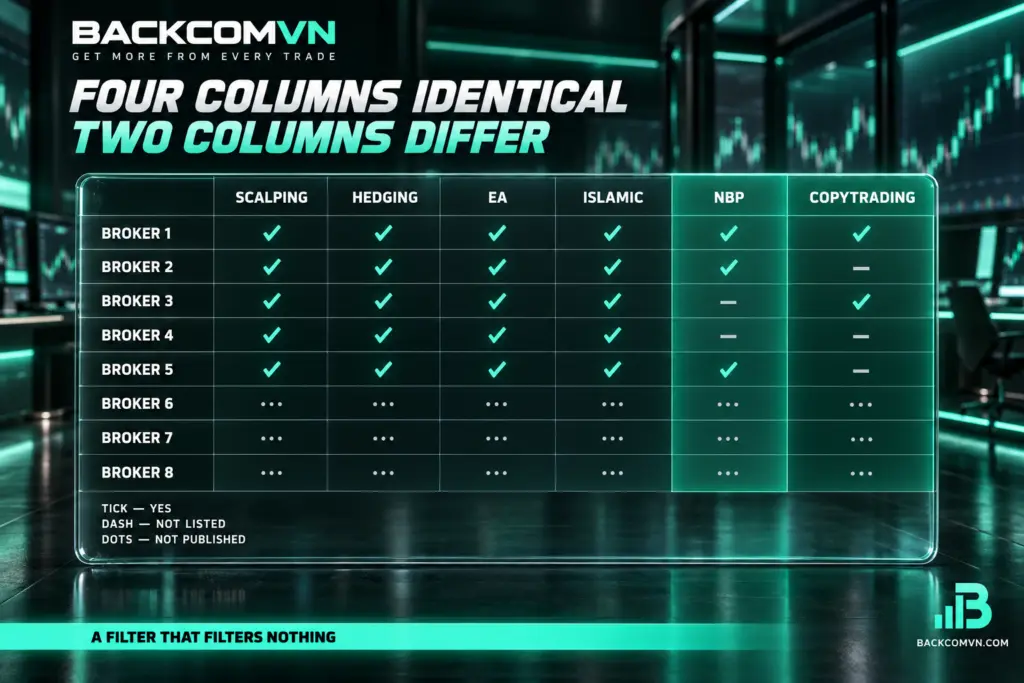
| Broker | Scalping | Hedging | EA | Islamic | NBP | CopyTrading |
|---|---|---|---|---|---|---|
| Exness | Yes | Yes | Yes | Yes | Yes | Not published |
| XM | Yes | Yes | Yes | Yes | Yes | Not published |
| IC Markets | Yes | Yes | Yes | Yes | Yes | Yes |
| Vantage | Yes | Yes | Yes | Yes | Not published | Not published |
| HFM | Yes | Yes | Yes | Yes | Not published | Yes |
| EC Markets | Not published | Not published | Not published | Not published | Not published | Not published |
| VT Markets | Not published | Not published | Not published | Not published | Not published | Not published |
| Ultima Markets | Not published | Not published | Not published | Not published | Not published | Not published |
“Not published” means precisely that: the data we reconcile has no entry for it, not that the broker has answered no. How we handle gaps like these is set out in our editorial standards.
Read the table down the columns and the interesting part appears: the first four columns are essentially identical across the five brokers with data. Only the last two — NBP and CopyTrading — separate them at all. And of those two, NBP is by far the one worth your attention.
NBP: more important than all three permissions combined
What NBP is
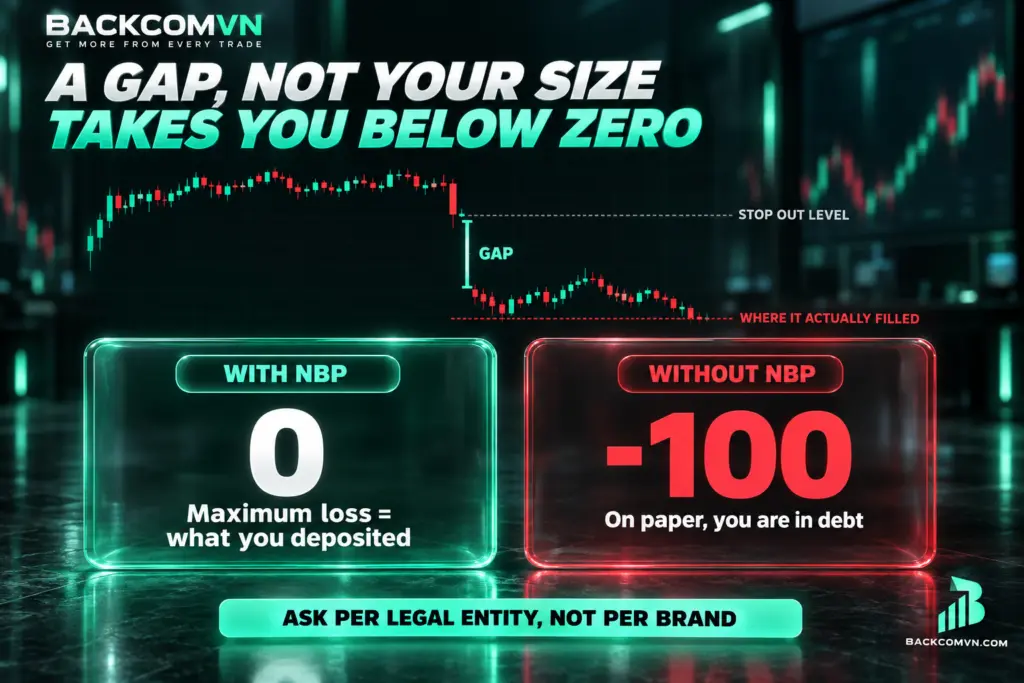
NBP stands for Negative Balance Protection. It answers one very specific question: if the market jumps through your stop out level and the account goes below zero, do you owe the broker that shortfall?
Normally margin call and stop out close positions before the account empties. But sometimes they cannot act in time: a weekend gap, an unexpected central bank decision, or liquidity vanishing for a few seconds. The opening price can sit far from your stop out level, the fill comes in much worse, and the balance drops below zero.
With NBP, the broker writes off the shortfall and your maximum loss is what you deposited. Without it, on paper you are in debt. The mechanics are in if my account goes negative, do I owe the broker.
Three state it, two do not, three publish nothing
Exness, XM and IC Markets all list NBP among their features. Vantage and HFM publish feature data but NBP is not in it. The other three publish nothing here at all.
That difference matters far more than scalping does. If scalping is forbidden you change how you trade; if a negative balance is not written off you lose more than you deposited. One is an inconvenience, the other is financial exposure.
One point to be clear about: NBP usually attaches to the legal entity that contracts with you, not to the brand. Under the same broker name, a client of the European entity may be protected by regulation while a client of an offshore entity is not. So reading the company name in your client agreement matters more than reading the feature list on the homepage — see licences at eight brokers.
The other two items: Islamic and CopyTrading
Islamic accounts — all five have them, on different terms
An Islamic account, also called swap-free, charges no overnight financing. All five brokers with data offer one. But “offers one” is not the same as free: many brokers replace swap with an administration charge accruing per day held, and on some instruments that charge exceeds the original swap.
If you are planning to use this account type to avoid overnight financing on longer holds, read is a swap-free account really free first — and check the specific instrument you trade, not the general case.
CopyTrading — only two state it
HFM and IC Markets list CopyTrading among their features. The other three with data do not — which does not mean they have no comparable product under a different name, so ask directly if you need it.
The more important caveat: copy trading replaces the question “how do I trade” with “whom do I trust”, and its cost usually sits not in the spread but in profit sharing or management fees. Copy trading: the advantages and what they cost goes into that.
“Permitted” is not “workable”
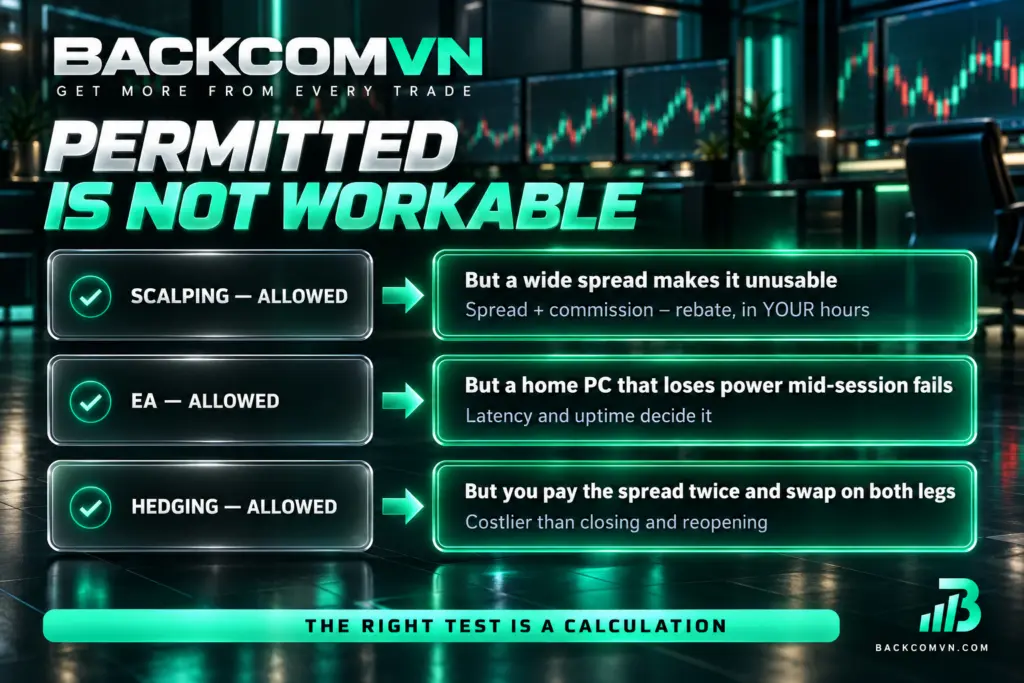
This is what the table cannot tell you, and the reason not to choose a broker by counting the word “Yes”.
Scalping is permitted, but costs can kill the strategy
Scalping pays the spread many times per session, so a broker that permits scalping with a wide spread is not actually usable for scalping. Add slippage on top — on fast entries and exits, a few tenths of a pip per trade compounds faster than you expect.
The right test is not “does this broker allow scalping” but “what is spread plus commission minus rebate during the hours I actually trade”. That number decides it, not a “Yes” in a table. And if you trade around news, spread widening around news changes the arithmetic entirely.
EAs are permitted, but infrastructure decides the outcome
The broker allowing EAs is the necessary condition. The sufficient one is elsewhere: whether your machine runs 24/5, what your latency to the server is, and whether the robot tolerates the spread conditions of the account type you opened. Most EA failures are not caused by broker restrictions but by running on a home computer that loses power or connectivity mid-session — which is when a VPS is worth considering.
And before worrying about infrastructure, reset your expectations of the robot itself: trading robots and EAs: realistic expectations.
Hedging is permitted, and still costs money
Holding two opposing positions on the same instrument means paying the spread twice and paying swap on both legs. Many people use hedging to “pause” a losing position, but in cost terms it is more expensive than closing and reopening. When it genuinely helps is covered in hedging in forex: when it helps and when it costs you.
How to check the three brokers that publish nothing
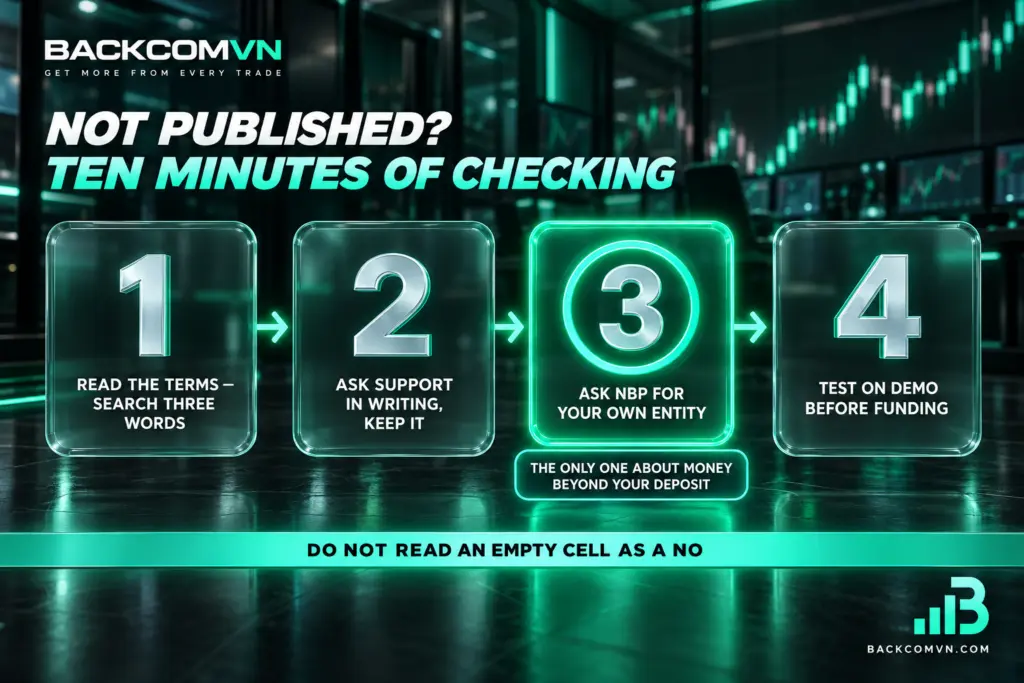
For EC Markets, VT Markets and Ultima Markets the table is empty. Do not read that as “not allowed”, and do not read it as “allowed” either. Do these four things instead; it takes about ten minutes:
- Open the trading terms and search for three words. Look for “scalping”, “hedging” and “expert advisor” in the terms document. If a restriction exists, it is almost always there rather than on the marketing pages.
- Ask support in writing. Chat or email, ask the three questions, and keep the answer. A reply given over the phone is no use later.
- Ask about NBP for your specific entity. Do not ask “does this broker have NBP” — ask “which legal entity contracts with me, and does that entity write off negative balances”.
- Test on demo before funding. Open two opposing positions to see whether the system permits it; attach a simple EA to see whether it runs. Using a demo account productively is covered here.
Step 3 is the one most people skip. It is also the only one of the four that concerns money you could lose beyond your deposit.
Frequently asked questions
Which broker is best for scalping?
This question has no answer in the form of a broker name, because all five with data permit it. Reframe it as: which broker has the lowest net cost for my volume and my hours. That is an arithmetic problem, and which broker has the lowest spread explains why every spread ranking is missing half the picture.
I trade small volume — do I need NBP?
Small volume makes a negative balance less likely, not impossible — because what causes it is a price gap, not your position size. On a small account the shortfall is small too, but the principle is unchanged: knowing your maximum loss in advance beats not knowing it.
The broker allows EAs, so why was my account closed?
Allowing EAs does not mean allowing every strategy. Many brokers’ terms specifically exclude strategies that exploit price latency or quoting errors. If you use a purchased EA, find out which category it falls into before running size.
Do these features affect my rebate?
No. Rebates are calculated from traded volume and account type. Running an EA or trading manually, scalping or holding for days, all count the same per lot. The indirect point worth noting is that scalping generates more lots in the same period, so the rebate accumulates faster — but trading costs accumulate just as fast, so do not treat that as a reason to trade more.
Are Islamic accounts only for Muslim clients?
The name comes from that, but eligibility varies by broker and many do not ask for proof of religion. Even so, do not open one just because it says no overnight financing — compare the replacement administration charge against the original swap on the instrument you actually trade.
Conclusion
Scalping, hedging and EAs are the three most commonly asked questions and the three worst at distinguishing brokers: all five with data here permit all three. If you are using them as selection criteria, you are filtering with a filter that filters nothing.
The two items that genuinely differ are NBP and CopyTrading, and NBP matters far more because it decides whether you can lose more than you deposited. Ask about it per contracting entity, not per brand. For the three brokers that publish nothing, the four checks above take ten minutes and give you a more reliable answer than any comparison table.
This content is informational. It is not investment advice and not a promise of returns. Leveraged forex and CFD trading carries a high level of risk and can result in the loss of all invested capital. Trading terms and feature lists can change, and several items depend on the legal entity that contracts with you — verify them against the official terms and your own client agreement.
The Backcom VN editorial team
The Backcom VN editorial team tracks forex trading costs: the fee schedules, rebate levels and licences of eight brokers, together with the market figures that feed into the cost of each trade. Every number we publish carries a public source and the date it was accessed, so you can check it yourself.
Related articles

Licences at eight brokers: the full comparison
Every licence the eight brokers publish, with numbers so you can verify them yourself. The key point: the FCA licence…

Which forex broker is trustworthy? The question to ask instead
Licences across eight brokers, plus what the table does not say: international clients are nearly always on an offshore entity,…

Where to look up a broker's licence: a regulator directory
Eight regulators with where to search each, and a four-step verification. The last step — matching the permitted scope of…

Which broker has the lowest minimum deposit - and why it barely matters
HFM from $0, XM from $5, Exness from $10, Vantage from $50. But the deposit threshold does not reduce risk…

Transferring your account to a new IB: the process and the catches
A five-step process and four things to check first. Spread, leverage and trading conditions stay exactly as they were —…

Tax on trading income: what is known and what is not
There is no specific guidance for this kind of income in Vietnam. The most important thing is to keep complete…